A while ago I wrote a short, personal piece about a building that I feel a strong connection to; namely the Odeon Cinema in Bradford. The piece was submitted for inclusion on the excellent Culture Vultures website and subsequently several readers of that estimable organ added their comments. A discussion ensued.
Now, I'm by no means the first to write about the parlous state of one of the finest examples of a 1930s Super Cinema still in existence. Many others have written much more eloquent pieces on the matter. Feelings about the issue over the years have led to people expressing their love for the building in ever more imaginative ways. Indeed, the Bradford Odeon Rescue Group (BORG) have recently celebrated their 10th birthday, and their campaign to 'Save the Odeon' has kept the fate of the building a hot topic in the City.
When it was discovered that the fabric of The Odeon was not in such dire state as had been previously described by our local press - with an agenda - and video footage emerged showing original features and clear potential for refurbishment, the City once more galvanised itself and spoke out. Further nefarious dealings were uncovered between the developers who wanted to pull down the cinema and replace it with an office/hotel/apartments complex, and The Homes and Communities Agency, and the pressure mounted. As the City Park was opened, we all kept our eyes on The Odeon! Thanks to the sheer determination and doggedness of a small, but ever growing, group of people who attracted the attention of the media and high-profile figures from the film, architecture, arts and entertainment world, there will soon be an announcement about the fate of one of Bradford's best loved buildings.
On Twitter I pledged 100 hours of my time as a volunteer to help with any restoration, renovation or regeneration of The Odeon. I asked others to pledge their time, too, and many did. There is a real sense of community now, with a common goal of reclaiming The Odeon for the City. There will no doubt be a number of potential plans for its future use. For a while there was talk of the possibility of the building housing a northern branch of The John Peel Centre for the Arts to compliment the one opened in Stowmarket, Suffolk.
Whatever the eventual plans - concert venue, arts complex, gallery - there should be a very strong community element to any scheme put forward. The Odeon has played a part in the lives of so many Bradfordians; so many stories have been and will continue to be told about it. There is an opportunity to create a real meeting place where those stories can be shared between the generations and different peoples of Bradford. The campaign to save this building got people talking, discussing, arguing - communicating - and at a time when voices are being silenced, and opinions sidelined, a place where expression is encouraged (in whatever form that might take) should be a priority.
For the latest news on the Bradford Odeon please check out the City of Film website, and the BORG website
Tuesday, 6 November 2012

Saturday, 27 October 2012
So Much To Say...So Little Time
After quite a lengthy hiatus, I have finally found myself a little time to update this blog.
A new, cleaner page layout, and the chance to write a new post. I should probably do something about that dreadful profile picture but, hey, it hasn't put either of my readers off so far.
The problem is; what to blog about? So much to say but so little time. Since my last post about (ir)responsibility in film advertising, a wide range of topics have presented themselves for comment but, luckily for the world at large, I haven't had the time to sound off about any of them. Here is just a short list of potential subjects;
The Olympics and Paralympics, the dismantling of the NHS, the erosion of the education system, Bradford Odeon, Bradford itself, opportunities for young people, Michael Bloody Gove and his iniquitous plans to sell off school playing fields, the building of increasingly rich (in the right sense) cultural and creative communities to kick-start regeneration, etc. etc.
None of them particularly original, all of them discussed in-depth elsewhere, but each of them worthy of attention. The problem has been finding the time to make more than a passing comment on anything - being so busy at work that the idea of indulging my opinionated self with the opportunity to whinge seems ridiculous - being there for the family, not away in cyberspace disappearing up my own rhetoric. But...I have missed having the chance to express an opinion once in a while.
So the plan is to get back in the writing saddle and ride the range of opportunity.
Thank you for your patience.
A new, cleaner page layout, and the chance to write a new post. I should probably do something about that dreadful profile picture but, hey, it hasn't put either of my readers off so far.
The problem is; what to blog about? So much to say but so little time. Since my last post about (ir)responsibility in film advertising, a wide range of topics have presented themselves for comment but, luckily for the world at large, I haven't had the time to sound off about any of them. Here is just a short list of potential subjects;
The Olympics and Paralympics, the dismantling of the NHS, the erosion of the education system, Bradford Odeon, Bradford itself, opportunities for young people, Michael Bloody Gove and his iniquitous plans to sell off school playing fields, the building of increasingly rich (in the right sense) cultural and creative communities to kick-start regeneration, etc. etc.
None of them particularly original, all of them discussed in-depth elsewhere, but each of them worthy of attention. The problem has been finding the time to make more than a passing comment on anything - being so busy at work that the idea of indulging my opinionated self with the opportunity to whinge seems ridiculous - being there for the family, not away in cyberspace disappearing up my own rhetoric. But...I have missed having the chance to express an opinion once in a while.
So the plan is to get back in the writing saddle and ride the range of opportunity.
Thank you for your patience.
Saturday, 7 April 2012
Sense Not Censorship 2 - Movie Posters
Let us get something clear, right from the off; I am in no way a prude, nor do I think that creative people should be subject to draconian censorship. However, I do believe, wholeheartedly, that those same creative people should be prepared to take responsibility for what they put into the public domain.
The case in point here is film posters. We know that there is a massive publicity machine behind the promotion of new movies - how else do they generate an audience to see the movies in the first place? We also know that the saturation point for media output has been met. So it would seem that the PR and marketing teams behind most new releases have run out of original ideas and now resort to lowest common denominator shock tactics. Or innuendo. Or, as in the example below, both.

As a parent of young children I think it should be my right to walk through my City centre, use public transport, or (retro-bloke that I am) use a phonebox occasionally without being confronted with an array of graphic, violent or gory images that I then have to try to explain to a confused, frightened or bewildered child. These same images should not be displayed on hoardings or those scrolling advertising boards. In a magazine that I can choose not to buy; fine. In certain parts of the cineplex not frequented by families with children; no problem. All it takes is a little sense, a little bit of thought.

We complain that our young people are increasingly violent, sexualised, horror-fixated, and disengaged from reality and then proceed to fill every available space with imagery that promotes violence, sex, and horror. The posters for each of the 'Saw' movies have been progressively grim. Graphically clever you might argue, but are they really suitable to be plastered anywhere and everywhere? Does the presence of a gun really enhance the attractiveness of the movie's hero/heroine? If so, are we really comfortable with this fact if we actually stop to think about the repercussions? Do the PR gurus deem the intelligence of the average cinema-goer to be so low that they cannot tell that a film is a thriller without there needing to be at least one firearm in the imagery? Never mind the Freudian aspect of guys and their guns!

I have chosen a few images to illustrate this post. I chose them quickly and there are many, many more examples of graphic, violent and just plain naff imagery that I could have picked. I return to my original statement: I do not wish to stop the creation of such material, I just wish some thought went into where it was placed.
UPDATE: May 2012
The latest offering from Mel Gibson - "How I Spent My Summer Vacation" - another example of the glorification of guns!

The case in point here is film posters. We know that there is a massive publicity machine behind the promotion of new movies - how else do they generate an audience to see the movies in the first place? We also know that the saturation point for media output has been met. So it would seem that the PR and marketing teams behind most new releases have run out of original ideas and now resort to lowest common denominator shock tactics. Or innuendo. Or, as in the example below, both.
As a parent of young children I think it should be my right to walk through my City centre, use public transport, or (retro-bloke that I am) use a phonebox occasionally without being confronted with an array of graphic, violent or gory images that I then have to try to explain to a confused, frightened or bewildered child. These same images should not be displayed on hoardings or those scrolling advertising boards. In a magazine that I can choose not to buy; fine. In certain parts of the cineplex not frequented by families with children; no problem. All it takes is a little sense, a little bit of thought.
We complain that our young people are increasingly violent, sexualised, horror-fixated, and disengaged from reality and then proceed to fill every available space with imagery that promotes violence, sex, and horror. The posters for each of the 'Saw' movies have been progressively grim. Graphically clever you might argue, but are they really suitable to be plastered anywhere and everywhere? Does the presence of a gun really enhance the attractiveness of the movie's hero/heroine? If so, are we really comfortable with this fact if we actually stop to think about the repercussions? Do the PR gurus deem the intelligence of the average cinema-goer to be so low that they cannot tell that a film is a thriller without there needing to be at least one firearm in the imagery? Never mind the Freudian aspect of guys and their guns!
UPDATE: May 2012
The latest offering from Mel Gibson - "How I Spent My Summer Vacation" - another example of the glorification of guns!
Thursday, 15 March 2012
Positive Bradford
Just lately there has been much love shown to my hometown; Bradford. Usually the city is a butt of someone's joke or held up as an example of all that is wrong with 'multicultural' and 'segregated' Britain. But, just lately, this has changed and instead of the lazy stereotypes we have been feted as an example of all that is positive about multicultural Britain.
Thanks to some ill-considered programme making by Channel 4, whose recent two-part social experiment to "Make Bradford British" caused an upswell in indignation, there has been a plethora of bloggers, writers and journalists (as well as many everyday Bradfordians) who have stood up and declared their allegiance to our city.
Much has been written already about the TV programme and its slanted portrayals by better writers and advocates than me. I refer you to their words at this point. Kate Wellham, Irna Qureshi, Bradfordia, John Atkinson and others all write passionately, wittily and wisely about Worstedopolis!
But my point is that whatever your take on the media's representations or other people's prejudices, they have stirred up debate around some issues that we still do not like talking about. As Oscar Wilde said, "There is only one thing worse than being talked about and that is not being talked about" and people are certainly talking about us now. What has pleased me the most is that, at last, we have sidled out from under the shadow of Leeds and have begun to be positive about our home. I won't add to the word count on the matter any further but below are some photos I have taken over the past year or so as the city has begun to hold its head up.


Thanks to some ill-considered programme making by Channel 4, whose recent two-part social experiment to "Make Bradford British" caused an upswell in indignation, there has been a plethora of bloggers, writers and journalists (as well as many everyday Bradfordians) who have stood up and declared their allegiance to our city.
Much has been written already about the TV programme and its slanted portrayals by better writers and advocates than me. I refer you to their words at this point. Kate Wellham, Irna Qureshi, Bradfordia, John Atkinson and others all write passionately, wittily and wisely about Worstedopolis!
But my point is that whatever your take on the media's representations or other people's prejudices, they have stirred up debate around some issues that we still do not like talking about. As Oscar Wilde said, "There is only one thing worse than being talked about and that is not being talked about" and people are certainly talking about us now. What has pleased me the most is that, at last, we have sidled out from under the shadow of Leeds and have begun to be positive about our home. I won't add to the word count on the matter any further but below are some photos I have taken over the past year or so as the city has begun to hold its head up.


Sunday, 19 February 2012
Home Tourist 4 - Bingley Five Rise Locks
As we live no more than five minutes' walk from the Leeds & Liverpool Canal in Bingley, when I heard on local radio that there would be an opportunity to walk through the famous Five Rise Locks, we jumped at the chance. The locks were in the process of being restored and new gates had only just been fitted. In order to complete this major project, the lock system had been drained and, for one weekend only, the public were given access. So, on the 28th of January, my youngest daughter and I donned our wellies and set off.
Bingley Five Rise Locks are one of the major landmarks of the national waterway network and have been described as one of the ‘Seven Wonders of the Waterways’. An 18th century engineering masterpiece built by John Longbotham, these five locks operate as a 'staircase' flight – in which the lower gate of one lock forms the upper gate of the next. When completed in 1774, thousands gathered to watch the first boats make the 60 foot descent.

We walked along the familiar stretch of towpath from Bingley Three Rise Locks, our point of access, and joined the large number of other people who were heading in the same direction. The towpath is a popular route for walkers and cyclists all year round but this was the busiest I have ever seen it. Luckily the weather was dry, bright and crisp which added to the enjoyment. The locks had been open to the public since 10:00am and already several hundred people had made the trip through them.
We arrived at about 2:00pm and made our way to the end of the queue that was snaking back over the swing bridge and up towards the Fairfax Road allotments. The queue was made up of a diverse range of people; families, ramblers, those with an interest in engineering or local history. Everyone chatted amiably and, with a few exceptions, nobody minded the wait. Several people commented on the numbers that had made the trip to see the locks and how the owners of the Five Rise cafe must have been looking forward to the best weekend of the year.

As the queue gradually moved forward (with more people arriving all the time) we overheard one of the renovation team on his mobile phone, "We're going to have to stay open a little later than planned...check with the volunteers that they can stay on after four..." How great that so much interest was being taken in our little piece of industrial heritage. Mini was certainly excited by the prospect of walking through the locks. "Will it be muddy?", she asked with a glint in her eye.
After 25 minutes or so we reached the head of the queue. As we carefully clambered down the first temporary staircase into the top lock chamber the scale of the project began to dawn. The water had been drained from the locks, and small pumps in each chamber were dealing with any seepage. Looking upstream, I could see the planks of wood laid one on top of the next to form a water-tight barrier. It seemed sturdy enough..."I hope so", said the cheerful volunteer who was stationed at this point, "It's all that is keeping back sixteen miles of canal!"

Once in the lock itself, you can really appreciate the skill of the craftsmen who were involved in the original building of the canal. Blocks of stone three feet wide, stretching up over ten meters above our heads. To one side was a hole in the wall big enough for mini to climb inside. This was one of the sluice outlets that help to fill the locks as they are required. Down here, awed by the sheer scale, it was easy to imagine the sheer hard work involved in digging out the channel, lining it and making it all function. All done, of course, with hand tools; you could almost hear the echoes of the pick axes and shovels.

We moved through the five locks and I cursed myself for not bringing my DSLR camera. Plenty of people had and were capturing the day both in stills and on video. Beneath one of the new gates we listened to another volunteer who was explaining about how they were made locally in one of only two workshops in the country capable of doing it. Each door is handmade to fit from English Green Oak and weighs five tonnes. With the weight of the water in the lock when they are operational, each door will weigh nearer twenty-five tonnes. The pairs of doors cost in the region of £25,000 to make and are expected to last up to thirty years. The top set they are replacing had lasted over forty years but with new regulations on the kinds of preservatives that can be used it is unlikely that these new ones will have as long a life.

Looking back up the flight of locks, I was really pleased that I had made the effort to come and see them from this unique perspective. Mini had been fascinated by the whole adventure, and this was a fantastic opportunity to experience some real living history.

As we climbed the staircase and stood on the side of the bottom lock, a small, tourist boat edged its way into the mouth of the lock for a close up look at the new gates. Mini waved at the passengers and squeezed my hand. "They can't walk inside it, can they?" she said. "No, but we have. Did you enjoy it?"
"Yeah!", she replied, "It was cool!...but not very muddy"
She seemed almost disappointed.
 |
| Bingley Five Rise Locks - photo courtesy of Waterscape.com |
Bingley Five Rise Locks are one of the major landmarks of the national waterway network and have been described as one of the ‘Seven Wonders of the Waterways’. An 18th century engineering masterpiece built by John Longbotham, these five locks operate as a 'staircase' flight – in which the lower gate of one lock forms the upper gate of the next. When completed in 1774, thousands gathered to watch the first boats make the 60 foot descent.
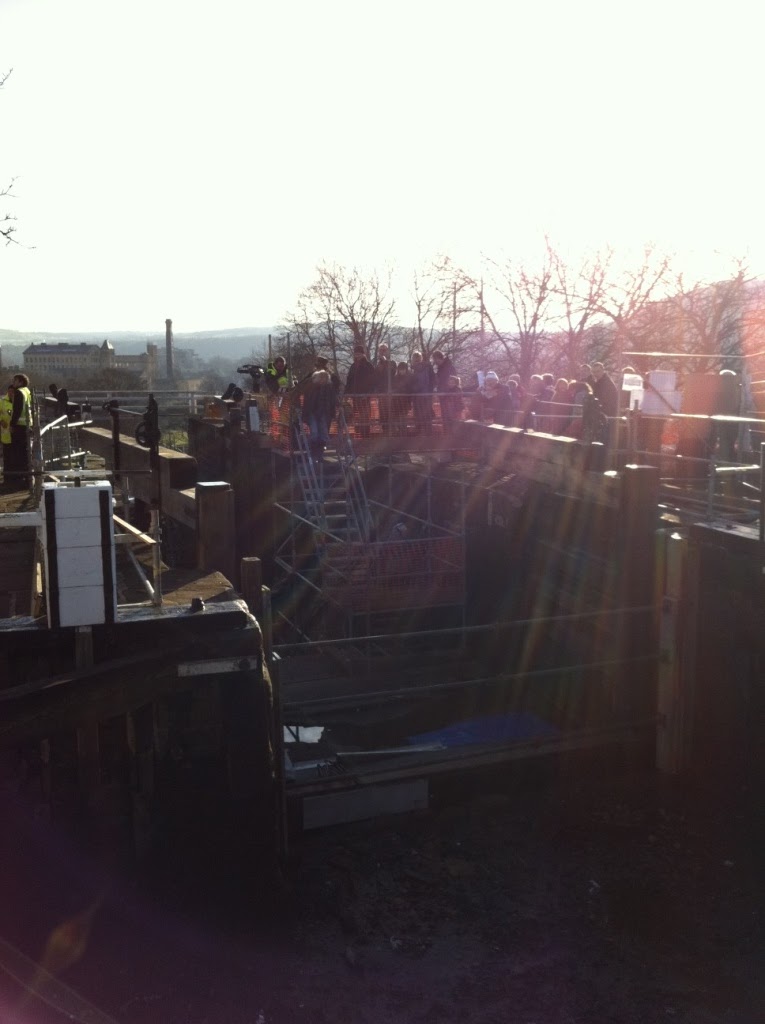
We arrived at about 2:00pm and made our way to the end of the queue that was snaking back over the swing bridge and up towards the Fairfax Road allotments. The queue was made up of a diverse range of people; families, ramblers, those with an interest in engineering or local history. Everyone chatted amiably and, with a few exceptions, nobody minded the wait. Several people commented on the numbers that had made the trip to see the locks and how the owners of the Five Rise cafe must have been looking forward to the best weekend of the year.

As the queue gradually moved forward (with more people arriving all the time) we overheard one of the renovation team on his mobile phone, "We're going to have to stay open a little later than planned...check with the volunteers that they can stay on after four..." How great that so much interest was being taken in our little piece of industrial heritage. Mini was certainly excited by the prospect of walking through the locks. "Will it be muddy?", she asked with a glint in her eye.
After 25 minutes or so we reached the head of the queue. As we carefully clambered down the first temporary staircase into the top lock chamber the scale of the project began to dawn. The water had been drained from the locks, and small pumps in each chamber were dealing with any seepage. Looking upstream, I could see the planks of wood laid one on top of the next to form a water-tight barrier. It seemed sturdy enough..."I hope so", said the cheerful volunteer who was stationed at this point, "It's all that is keeping back sixteen miles of canal!"

Once in the lock itself, you can really appreciate the skill of the craftsmen who were involved in the original building of the canal. Blocks of stone three feet wide, stretching up over ten meters above our heads. To one side was a hole in the wall big enough for mini to climb inside. This was one of the sluice outlets that help to fill the locks as they are required. Down here, awed by the sheer scale, it was easy to imagine the sheer hard work involved in digging out the channel, lining it and making it all function. All done, of course, with hand tools; you could almost hear the echoes of the pick axes and shovels.

We moved through the five locks and I cursed myself for not bringing my DSLR camera. Plenty of people had and were capturing the day both in stills and on video. Beneath one of the new gates we listened to another volunteer who was explaining about how they were made locally in one of only two workshops in the country capable of doing it. Each door is handmade to fit from English Green Oak and weighs five tonnes. With the weight of the water in the lock when they are operational, each door will weigh nearer twenty-five tonnes. The pairs of doors cost in the region of £25,000 to make and are expected to last up to thirty years. The top set they are replacing had lasted over forty years but with new regulations on the kinds of preservatives that can be used it is unlikely that these new ones will have as long a life.

Looking back up the flight of locks, I was really pleased that I had made the effort to come and see them from this unique perspective. Mini had been fascinated by the whole adventure, and this was a fantastic opportunity to experience some real living history.

As we climbed the staircase and stood on the side of the bottom lock, a small, tourist boat edged its way into the mouth of the lock for a close up look at the new gates. Mini waved at the passengers and squeezed my hand. "They can't walk inside it, can they?" she said. "No, but we have. Did you enjoy it?"
"Yeah!", she replied, "It was cool!...but not very muddy"
She seemed almost disappointed.
Wednesday, 28 December 2011
Home Tourist 3 - How Stean Gorge
Wanting a post-Christmas outing to blow away the cobwebs and work off a bit of the over-indulgence, the Monkeyclan decided to visit How Stean Gorge in Nidderdale. This part of the Yorkshire Dales is well-known for the spectacular scenery and geological wonders - there are caverns, river gorges and pot-holes aplenty. We wanted to get away from the city, into some nature, and have a scenic walk to stretch the legs. We got all that and more...

Situated 8 miles or so beyond the pretty Dales town of Pately Bridge, How Stean Gorge has been a visitor attraction since the Victorian era. The present owners have upgraded it considerably and it now offers outdoor adventure activities for families, schools groups, and even corporate training events. On our visit, on a slightly damp and drizzly late December day however, it was nice and quiet.
The drive from Pately Bridge takes you alongside the River Nidd for a fair distance before the immense expanse of Gouthwaite Reservoir appears. The reservoir is a Site of Special Scientific Interest, and home to a large number of bird species. There are several viewing areas along its shores that allow for a chance to observe the wildlife. This stretch of the road is very like those you find around the Lake District and the scenery is similar, with wooded slopes and rolling, heather strewn moorland above. Just beyond the attractive village of Lofthouse is the car-park and reception for How Stean Gorge. Slowly driving over the bridge to the car park gave our excited kids their forst glimpse of the gorge itself. Running for almost 1km in length and up to 20m deep in places, it is quite something.

The friendly receptionist welcomed us with a smile and, as she explained where to collect our hard hats and gave out the dynamo powered torches that we would need, she also pointed out the areas that could be slippery underfoot. At £16 for a family ticket (in our case two adults and three children) it is good value and certainly cheaper than a trip to the local cineplex. It is also way more fun!
We each took a hard hat from the bins at the entrance to the gorge and headed off along the path. This is not a suitable place for anyone with a pushchair or any mobility problems (although the cafe is wheelchair accessible) as the paths are uneven, narrow and follow the river's edge. The trail leads up river several metres above the river itself. From this vantage point it is easy to see the power of the water as it cascades through the narrow, limestone gorge. The rock has been eroded into twisting curves and the water froths and tumbles on its way downstream. The noise of the river echoes back and forth between the steep banks and adds to the atmosphere of adventure. We were only walking along the footpath and the adrenaline was flowing; it must be amazing to be scrambling and wading along the river itself, following the 'Via Ferrara' trail. This guided walk, wade, climb and abseil is bookable online and does look both exhilarating and terrifying in equal parts; especially as the safety lines, ariel ladders and walkways are clearly visible from the pathway. Needless to say, our fourteen year old son has requested that we book for him to go for his next birthday!

Today was to be rather more sedate although we did get to scramble along the river bank and feel the power of the water at close quarters. First, though, we headed along the trail to find Aslan. This carved wooden statue was apparently commissioned by Disney as promotion for the recent Chronicles of Narnia films, although quite how it ended up here is not entirely clear. Other information about the gorge is more forthcoming thanks to a series of information boards posted at regular intervals along the trail. These give historical, botanical and geological information as well as encouraging younger visitors to look out for various examples of wildlife and flora. At the end of the trail is How Stean Tunnel which provides some slightly more challenging terrain, with caves and rock formations to explore. Due to the high water levels we decided not to risk this particular section and, instead, headed back downstream towards Tom Taylor's Cave.
Crossing the gorge on one of the narrow beam footbridges, we made our way to the mouth of the Cave. Named after a local ne'er do well and highwayman, the cave is a 300ft tunnel under the river bank. Originally used by Tom Taylor as a hideout and store for his ill-gotten loot, this is a great first experience for a novice caver. Just inside the entrance to the cave, on the left, a rope allows access into a smaller chamber. It is a bit of a strenuous climb but well worth it. The main tunnel is entered via a wooden staircase. The passage is narrow and low at times (hence the hard hats!) but relatively easy going. Our five-year-old managed it and enjoyed using the torch she had been given to illuminate the rock formations and the sources of the water dropping from above. At the far end of the tunnel, as we had taken it, is 'the beehive chamber' and just beyond this a natural staircase leads upwards to emerge into daylight in 'Cat Hole' not far from the car park. It was here that Minimonkey was delighted to meet some of the local wildlife; a very cheeky and surprisingly confident robin came to investigate her boots.

We decided to make our way back through the cave to the river bank. Another narrow bridge took us across the river again to a long, low flat rock from which we skimmed stones and would probably have had our picnic had I not left it on the dining table at home. Instead we headed to the tearooms for a well-deserved cake and a cuppa. Having successfully navigated the river bank and twice through the cave, Minimonkey celebrated the end of her walk by having to be rescued from the top of the climbing frame in the small playground outside the cafe. The tearooms sell home-cooked food using locally sourced ingredients, as well as a selection of delicious cakes. I had never heard of it before but can heartily recommend the Jap. Once again the service was friendly and cheerful, and the lady in the cafe was very apologetic that there was nothing wheat or egg-free for Minimonkey to eat.
Feeling tired and happy, we chatted over our drinks and looked at the artworks by local artists that are displayed on the tearoom walls. Our favourite was the sculpture of a viking longboat made from retired stainless steel teapots and jugs from the cafe. After a quick visit to the loos and the obligatory stop at the small giftshop, we said goodbye and headed back in the fading daylight. Passing through the dusky countryside, seeing the Christmas lights in the houses of Lofthouse and Ramsgill, I turned to ask the Monkeykids what they had enjoyed most about the day...but they were all asleep in the back of the car.
Full details about How Stean Gorge can be found at their website.

Situated 8 miles or so beyond the pretty Dales town of Pately Bridge, How Stean Gorge has been a visitor attraction since the Victorian era. The present owners have upgraded it considerably and it now offers outdoor adventure activities for families, schools groups, and even corporate training events. On our visit, on a slightly damp and drizzly late December day however, it was nice and quiet.
The drive from Pately Bridge takes you alongside the River Nidd for a fair distance before the immense expanse of Gouthwaite Reservoir appears. The reservoir is a Site of Special Scientific Interest, and home to a large number of bird species. There are several viewing areas along its shores that allow for a chance to observe the wildlife. This stretch of the road is very like those you find around the Lake District and the scenery is similar, with wooded slopes and rolling, heather strewn moorland above. Just beyond the attractive village of Lofthouse is the car-park and reception for How Stean Gorge. Slowly driving over the bridge to the car park gave our excited kids their forst glimpse of the gorge itself. Running for almost 1km in length and up to 20m deep in places, it is quite something.

We each took a hard hat from the bins at the entrance to the gorge and headed off along the path. This is not a suitable place for anyone with a pushchair or any mobility problems (although the cafe is wheelchair accessible) as the paths are uneven, narrow and follow the river's edge. The trail leads up river several metres above the river itself. From this vantage point it is easy to see the power of the water as it cascades through the narrow, limestone gorge. The rock has been eroded into twisting curves and the water froths and tumbles on its way downstream. The noise of the river echoes back and forth between the steep banks and adds to the atmosphere of adventure. We were only walking along the footpath and the adrenaline was flowing; it must be amazing to be scrambling and wading along the river itself, following the 'Via Ferrara' trail. This guided walk, wade, climb and abseil is bookable online and does look both exhilarating and terrifying in equal parts; especially as the safety lines, ariel ladders and walkways are clearly visible from the pathway. Needless to say, our fourteen year old son has requested that we book for him to go for his next birthday!

Today was to be rather more sedate although we did get to scramble along the river bank and feel the power of the water at close quarters. First, though, we headed along the trail to find Aslan. This carved wooden statue was apparently commissioned by Disney as promotion for the recent Chronicles of Narnia films, although quite how it ended up here is not entirely clear. Other information about the gorge is more forthcoming thanks to a series of information boards posted at regular intervals along the trail. These give historical, botanical and geological information as well as encouraging younger visitors to look out for various examples of wildlife and flora. At the end of the trail is How Stean Tunnel which provides some slightly more challenging terrain, with caves and rock formations to explore. Due to the high water levels we decided not to risk this particular section and, instead, headed back downstream towards Tom Taylor's Cave.
Crossing the gorge on one of the narrow beam footbridges, we made our way to the mouth of the Cave. Named after a local ne'er do well and highwayman, the cave is a 300ft tunnel under the river bank. Originally used by Tom Taylor as a hideout and store for his ill-gotten loot, this is a great first experience for a novice caver. Just inside the entrance to the cave, on the left, a rope allows access into a smaller chamber. It is a bit of a strenuous climb but well worth it. The main tunnel is entered via a wooden staircase. The passage is narrow and low at times (hence the hard hats!) but relatively easy going. Our five-year-old managed it and enjoyed using the torch she had been given to illuminate the rock formations and the sources of the water dropping from above. At the far end of the tunnel, as we had taken it, is 'the beehive chamber' and just beyond this a natural staircase leads upwards to emerge into daylight in 'Cat Hole' not far from the car park. It was here that Minimonkey was delighted to meet some of the local wildlife; a very cheeky and surprisingly confident robin came to investigate her boots.

We decided to make our way back through the cave to the river bank. Another narrow bridge took us across the river again to a long, low flat rock from which we skimmed stones and would probably have had our picnic had I not left it on the dining table at home. Instead we headed to the tearooms for a well-deserved cake and a cuppa. Having successfully navigated the river bank and twice through the cave, Minimonkey celebrated the end of her walk by having to be rescued from the top of the climbing frame in the small playground outside the cafe. The tearooms sell home-cooked food using locally sourced ingredients, as well as a selection of delicious cakes. I had never heard of it before but can heartily recommend the Jap. Once again the service was friendly and cheerful, and the lady in the cafe was very apologetic that there was nothing wheat or egg-free for Minimonkey to eat.
Feeling tired and happy, we chatted over our drinks and looked at the artworks by local artists that are displayed on the tearoom walls. Our favourite was the sculpture of a viking longboat made from retired stainless steel teapots and jugs from the cafe. After a quick visit to the loos and the obligatory stop at the small giftshop, we said goodbye and headed back in the fading daylight. Passing through the dusky countryside, seeing the Christmas lights in the houses of Lofthouse and Ramsgill, I turned to ask the Monkeykids what they had enjoyed most about the day...but they were all asleep in the back of the car.
Full details about How Stean Gorge can be found at their website.
Sunday, 20 November 2011
The Soul of the City
This article originally appeared on the CultureVulture website.
There are some buildings that fulfil an important role in the fabric of people's lives. Depending on one's viewpoint and experience, a solid argument could be made for any number of buildings - churches, schools, hospitals, libraries etc. Indeed, architects would certainly argue that all buildings are important else why build them in the first place? However, there are some buildings which hold a more central place in people's affections; I can't imagine too much protest over the demolition of the local tax office.

In Bradford one such building is the old Odeon Cinema. Originally built in 1929, the imposing art deco building was, at one time, the third largest entertainment venue in the country, boasting a ballroom, restaurant and large-scale auditorium. In the 1960s it became part of the Gaumont circuit, attracting top names from the rock and pop world including Tom Jones, The Rolling Stones, and The Beatles. Famously, John Lennon found himself in need of a dentist whilst in Bradford, and nipped up Thotnton Road to attend a local surgery between the matinee and evening shows. A refit in the late 1960s covered up much of the Odeon's splendour but, thankfully, many of the original fixtures, features and fittings remain behind stud walls and breezeblocks. A detailed history of the building, along with images from its heyday can be found on the Bradford Odeon Rescue Group website.
This was the cinema where I first saw Star Wars, queuing around the block to get in. I saw The Spy Who Loved Me at the Odeon; saw my first 'A' rated film - we sneaked in to watch Kramer vs Kramer having paid to see Pete's Dragon. I was here when a cinema full of skinheads, scooter boys and rude girls moon stomped in the aisles as the film Dance Craze played on the screen. It was here that I saw Close Encounters of the Third Kind. It was here that I had my first close encounter of the teenage kind during a showing of Mannequin!
Even when the owners decided to maximise profit by splitting the big auditorium into two, then three smaller screens, the magic continued. When my wife and I first got together, some of our earliest dates were at The Odeon; we took our son to see The Tigger Movie, his first big-screen experience; all milestones in our family's shared history. These experiences are multiplied across the many tens of thousands of other Bradfordians who used to go to The Odeon.
The beautiful building remains, slowly rotting through neglect whilst around it other construction sites throw up modern glass and steel office blocks and anonymous chain hotels that literally reflect the shabbiness of this once great palace of entertainment. Just a few metres away across the busy dual carriageway that slices through the city centre, the City Park nears completion. This £24m development will give Bradford the largest city centre water feature in Europe. It comprises approximately six acres of paved and landscaped walkways that can be flooded and drained as required. More than a hundred controllable fountains will play, creating dynamic water sculptures, beneath the tall, reed-like floodlights that will illuminate the space at night.

Now, I am an optimistic person and can already see some benefits from the City Park development, not least of which is the opening up of the skyline across the Centenary Square. Now it is possible to look from the stunning Italianate City Hall building right across to The Alhambra Theatre. The Sixties brutalist home of The National Media Museum looks down from one side, whilst from the other stares the modern edifice of the Provident Financial building - several eras of architectural style collected together. But slap bang in the middle, like a derelict and decrepit dowager aunt, sits The Odeon. Incongruous, neglected, but, stubbornly, still there.
The Council have shown a woeful lack of vision regarding the Odeon. Where other cities would have capitalised on the architectural harmony between The Alhambra Theatre and the Odeon, creating a cultural quarter for the city like Sheffield has done, Bradford Council have hesitated and capitulated as property developers and private financiers have paraded one unwanted or unworkable scheme after another through the planning office. As everyone's attention was drawn to the ill-considered and ultimately ill-fated Westfield development planned for the site of the original Forster Square, the Odeon was quietly sold, only to be left to crumble. Very few Bradfordians actually thought we needed a new shopping centre (the Forster Square Retail Park - as soulless as it sounds - had driven a stake through the heart of the City's central shopping area already) but pretty much everyone who was asked or who offered their opinions wanted the Odeon to be saved.
So what happens to a city's collective memories and experiences once such a place is pulled down? And how do those people feel when their opinions are sought only to be ignored? When they have clearly expressed their wishes regarding the future of the building, through letters to the council, representations to English Heritage, and through a large-scale public demonstration of their support for it, and for all of that to be disregarded; what then?
There are some buildings that fulfil an important role in the fabric of people's lives. Depending on one's viewpoint and experience, a solid argument could be made for any number of buildings - churches, schools, hospitals, libraries etc. Indeed, architects would certainly argue that all buildings are important else why build them in the first place? However, there are some buildings which hold a more central place in people's affections; I can't imagine too much protest over the demolition of the local tax office.

In Bradford one such building is the old Odeon Cinema. Originally built in 1929, the imposing art deco building was, at one time, the third largest entertainment venue in the country, boasting a ballroom, restaurant and large-scale auditorium. In the 1960s it became part of the Gaumont circuit, attracting top names from the rock and pop world including Tom Jones, The Rolling Stones, and The Beatles. Famously, John Lennon found himself in need of a dentist whilst in Bradford, and nipped up Thotnton Road to attend a local surgery between the matinee and evening shows. A refit in the late 1960s covered up much of the Odeon's splendour but, thankfully, many of the original fixtures, features and fittings remain behind stud walls and breezeblocks. A detailed history of the building, along with images from its heyday can be found on the Bradford Odeon Rescue Group website.
This was the cinema where I first saw Star Wars, queuing around the block to get in. I saw The Spy Who Loved Me at the Odeon; saw my first 'A' rated film - we sneaked in to watch Kramer vs Kramer having paid to see Pete's Dragon. I was here when a cinema full of skinheads, scooter boys and rude girls moon stomped in the aisles as the film Dance Craze played on the screen. It was here that I saw Close Encounters of the Third Kind. It was here that I had my first close encounter of the teenage kind during a showing of Mannequin!
Even when the owners decided to maximise profit by splitting the big auditorium into two, then three smaller screens, the magic continued. When my wife and I first got together, some of our earliest dates were at The Odeon; we took our son to see The Tigger Movie, his first big-screen experience; all milestones in our family's shared history. These experiences are multiplied across the many tens of thousands of other Bradfordians who used to go to The Odeon.
The beautiful building remains, slowly rotting through neglect whilst around it other construction sites throw up modern glass and steel office blocks and anonymous chain hotels that literally reflect the shabbiness of this once great palace of entertainment. Just a few metres away across the busy dual carriageway that slices through the city centre, the City Park nears completion. This £24m development will give Bradford the largest city centre water feature in Europe. It comprises approximately six acres of paved and landscaped walkways that can be flooded and drained as required. More than a hundred controllable fountains will play, creating dynamic water sculptures, beneath the tall, reed-like floodlights that will illuminate the space at night.

Now, I am an optimistic person and can already see some benefits from the City Park development, not least of which is the opening up of the skyline across the Centenary Square. Now it is possible to look from the stunning Italianate City Hall building right across to The Alhambra Theatre. The Sixties brutalist home of The National Media Museum looks down from one side, whilst from the other stares the modern edifice of the Provident Financial building - several eras of architectural style collected together. But slap bang in the middle, like a derelict and decrepit dowager aunt, sits The Odeon. Incongruous, neglected, but, stubbornly, still there.
The Council have shown a woeful lack of vision regarding the Odeon. Where other cities would have capitalised on the architectural harmony between The Alhambra Theatre and the Odeon, creating a cultural quarter for the city like Sheffield has done, Bradford Council have hesitated and capitulated as property developers and private financiers have paraded one unwanted or unworkable scheme after another through the planning office. As everyone's attention was drawn to the ill-considered and ultimately ill-fated Westfield development planned for the site of the original Forster Square, the Odeon was quietly sold, only to be left to crumble. Very few Bradfordians actually thought we needed a new shopping centre (the Forster Square Retail Park - as soulless as it sounds - had driven a stake through the heart of the City's central shopping area already) but pretty much everyone who was asked or who offered their opinions wanted the Odeon to be saved.
So what happens to a city's collective memories and experiences once such a place is pulled down? And how do those people feel when their opinions are sought only to be ignored? When they have clearly expressed their wishes regarding the future of the building, through letters to the council, representations to English Heritage, and through a large-scale public demonstration of their support for it, and for all of that to be disregarded; what then?
Subscribe to:
Posts (Atom)