Sunday, 6 November 2022
Who Knows Where The Time Goes?
It is nine years, almost to the day, since I last posted anything on this blog. I found the (long forgotten) log in details in an old notebook, and spent a while re-reading the posts. What struck me, apart from a slight queasiness at reading my own words after quite a long break, was how things had not changed very much. At least not for the better. Many of the topics covered still resonate, still irk me, are still to be addressed. A fair few things have got markedly worse. Some things have improved or moved on - I'm looking at you Bradford Live.
In 2013, we were blissfully unaware of what would happen in three short years. Trump and Brexit were yet to lumber into view, wilfully wrecking everything along the way. 2020 was way off in the distance, the future setting of a speculative piece of theatre. When the company I was part of were devising the play, no-one had deadly pandemic, lockdowns and economic catastrophe on their list of possible scenarios. A cost of living crisis?
Looking back over these entries has been interesting and, with so much having happened in the last decade, I think I'll fire up the old ire and write some more. If anyone out there reads any of this; thank you.

Monday, 4 November 2013
Soft Options and Hard Choices
It will come as no surprise to anyone who has ever read this blog that last weekend's article in The Times outlining the latest plans to ensure rigour in our education system by removing so-called 'soft options' from the Curriculum somewhat got my goat. The subjects of Mr Gove's disapproval this time are Drama, PE, Media Studies, and Law. Subjects which the Secretary of State for Education deems unsuitable to be taken as GCSEs.

Well blow me down with a right-wing manifesto!
If there was ever further proof needed that Gove's 'reforms' were anything other than ideological, then here it is. Take a moment to read the list of 'soft' subjects again; Drama (about which much more later) PE, Media Studies and Law.
As someone who has worked in theatre and teaching for the best part of twenty five years, you won't be surprised that I will extol the myriad virtues of drama and performance (including music and dance) for the betterment of society until I am blue in the face. My previous post, entitled Uncomfortably Numb, sets out my stall about the absolute need for drama in education. Ironically, I don't teach GCSE Drama; we don't offer it, opting instead for the more vocational BTEC routes. And how Mr Gove hates those! But I will defend the right of all children to be able to study Drama as a GCSE.
I will also defend their right to study PE as a GCSE. If Mr Gove had his way, all the school playing fields would be sold off to private developers and school kids would be left to make do with a Wii-fit. Although he and all his Westminster friends are quick to bask in the reflected light of our Olympians and Paralympians and their success at London 2012, they do not feel the need to offer a qualification (or significant funding) to anyone who might just bring home the gold medals in 2016 or 2020.
Mr Gove is a former journalist - well, he worked for Rupert Murdoch which is close - but he doesn't want young people to learn about bias or representation, censorship or ethics. He doesn't want just any young council estate tearaway to have the opportunities offered to him. No articulate broadcasters who haven't been to Oxbridge. Anyway, just think of the savings his friends who run Academies and Free schools could make if they sold off the Mac computers, editing suite, cameras, tripods and other equipment. It wouldn't be long before all those expensive instruments and recording equipment were on EBay either. Oh, and the lighting rig; that drama studio will make a perfect exam hall.
The Law is the last refuge of the scoundrel, someone once said. It will also remain almost exclusively the preserve of the rich elite if Mr Gove has his plans approved. I am assured that, traditionally, no-one entering the legal profession would have a GCSE in Law. Instead they would probably have studied The Classics or Philosophy, Politics and Economics at University, and then specialised in Law. It is this tradition that I take issue with; why shouldn't a working class kid from Bradford, Birmingham, Barking or Barry Island have as much opportunity to study law as those from more affluent areas?
Much more has been written about the issue of 'soft options' - some fine examples can be found HERE
As parents and educators we face some very hard choices. Perhaps the most pressing is whether we are prepared to stand up to Gove's bullying tactics and fight for an education system free from political influence and one that is truly in the best interests of all children?
Well blow me down with a right-wing manifesto!
If there was ever further proof needed that Gove's 'reforms' were anything other than ideological, then here it is. Take a moment to read the list of 'soft' subjects again; Drama (about which much more later) PE, Media Studies and Law.
As someone who has worked in theatre and teaching for the best part of twenty five years, you won't be surprised that I will extol the myriad virtues of drama and performance (including music and dance) for the betterment of society until I am blue in the face. My previous post, entitled Uncomfortably Numb, sets out my stall about the absolute need for drama in education. Ironically, I don't teach GCSE Drama; we don't offer it, opting instead for the more vocational BTEC routes. And how Mr Gove hates those! But I will defend the right of all children to be able to study Drama as a GCSE.
I will also defend their right to study PE as a GCSE. If Mr Gove had his way, all the school playing fields would be sold off to private developers and school kids would be left to make do with a Wii-fit. Although he and all his Westminster friends are quick to bask in the reflected light of our Olympians and Paralympians and their success at London 2012, they do not feel the need to offer a qualification (or significant funding) to anyone who might just bring home the gold medals in 2016 or 2020.
Mr Gove is a former journalist - well, he worked for Rupert Murdoch which is close - but he doesn't want young people to learn about bias or representation, censorship or ethics. He doesn't want just any young council estate tearaway to have the opportunities offered to him. No articulate broadcasters who haven't been to Oxbridge. Anyway, just think of the savings his friends who run Academies and Free schools could make if they sold off the Mac computers, editing suite, cameras, tripods and other equipment. It wouldn't be long before all those expensive instruments and recording equipment were on EBay either. Oh, and the lighting rig; that drama studio will make a perfect exam hall.
The Law is the last refuge of the scoundrel, someone once said. It will also remain almost exclusively the preserve of the rich elite if Mr Gove has his plans approved. I am assured that, traditionally, no-one entering the legal profession would have a GCSE in Law. Instead they would probably have studied The Classics or Philosophy, Politics and Economics at University, and then specialised in Law. It is this tradition that I take issue with; why shouldn't a working class kid from Bradford, Birmingham, Barking or Barry Island have as much opportunity to study law as those from more affluent areas?
Much more has been written about the issue of 'soft options' - some fine examples can be found HERE
As parents and educators we face some very hard choices. Perhaps the most pressing is whether we are prepared to stand up to Gove's bullying tactics and fight for an education system free from political influence and one that is truly in the best interests of all children?
Tuesday, 4 June 2013
His Story Repeats
Recently, I have been working on the final performance project for our second year students. They have been rehearsing a show with the HND students: The Theatre Workshop's brilliant satire on the futility of conflict, 'Oh What A Lovely War'
At first they didn't quite get what the whole thing was about. The Music Hall style, the historical references, and their own lack of knowledge about the First World War were significant barriers to their enjoyment of and engagement with the material. This concerned me to begin with but then I came to understand some of the reasons behind what, at first, seemed like ignorance.
One of the frustrations that I have with the way in which (most) young people engage with the world is that they have been distracted from what really matters by the promise of a shiny, advanced and, above all, easy future - just as long as they leave all the messy decisions to somebody else. That is, I am aware, a huge sweeping generalisation and there are thousands of young people across the world,
right now, fighting, literally in many cases, for a better future. But in my small corner of the globe, the apathy and disengagement is worrying.
Being the performing arts, our courses attract more female students than male ones. I have written before about how we need to build the sense of self and self-worth in all our young people, especially girls. In one rehearsal we reached the scene in Oh What A Lovely War that features a brief appearance by the character of Mrs Pankhurst. In the scene, she is heckled by a crowd of onlookers as she attempts to spread her message of pacifism. This led to a discussion about attitudes to pacifism, conscientious objection, and the role of women in peace movements and politics. The young lady playing Mrs Pankhurst in the scene had heard of the Suffragette movement and knew it had something to do with the King's horse but beyond that, her knowledge was sketchy. After a further, brief discussion about the place of women in Edwardian society, we ran the scene again and the difference in the performance was a marked one: the young actress delivered her lines with conviction and a level of passion that she had, hitherto, not displayed. The 'crowd' reacted in kind and the scene took on a new intensity.
When I asked her what had caused the difference, the actress said, "It meant something...I just had to make them listen!" - she had connected with the material.
The rest of the rehearsal buzzed along nicely, feeding off the energy of that initial scene. As the session drew to a close I mentioned that there were a couple of programmes on TV that week that were about the Suffragette movement. Clare Balding's documentary about Emily Davidson and her fatal protest at The Derby, and a new comedy by Jessica Hynes, called 'Up The Women'.
At the next rehearsal, having watched the programmes, the young actress came in full of indignation at the fact that no-one at school had told her about the Suffragette movement in any detail. She felt that there was so much else to find out and know about - I was smiling by this point, knowing that a fire had been lit - and how "doing this play" had opened her eyes to how history shapes our lives. "It was never like that at school, even when we did do stuff about the First World War, it was always battles and generals and I found it boring. I learned more about attitudes to women in a half an hour comedy programme than I did in all my GCSE history classes."
We went on to discuss how theatre and literature can bring out the lessons and messages from historical events, and how playwrights use historical periods as allegories for their own times. We talked about 'The Crucible' and how that was really about American politics of the 1950s. We discussed Brian Friel's play, 'Making History' which is all about how history is written by the victors, and how facts can be manipulated to suit a particular agenda. We talked about how so much of history is written from a man's perspective. This brought us back to the use of propaganda in the First World War and how people at home were lied to about what was happening on the battlefields of Europe.
The discussion ended with us getting back onto the stage and blocking some of the scenes we had yet to stage. As we were about to start, the young actress said, "This is why I like doing theatre...it makes me think about things...and it makes me feel about them, too. Do you know what I mean?"
And I do.
At first they didn't quite get what the whole thing was about. The Music Hall style, the historical references, and their own lack of knowledge about the First World War were significant barriers to their enjoyment of and engagement with the material. This concerned me to begin with but then I came to understand some of the reasons behind what, at first, seemed like ignorance.
Without wishing to come over all Gove here - my regular reader will know that I have little or no sympathy with his particular (lack of) educational vision - it does seem to stem from the students' experience of history and, more specifically, how it is taught.
History is a continuum of events that we should, ideally, learn from and that can, sadly, be manipulated to serve any number of political or other nefarious means. It is complex and confusing.
A lot like the everyday life that we lead. One of the frustrations that I have with the way in which (most) young people engage with the world is that they have been distracted from what really matters by the promise of a shiny, advanced and, above all, easy future - just as long as they leave all the messy decisions to somebody else. That is, I am aware, a huge sweeping generalisation and there are thousands of young people across the world,
right now, fighting, literally in many cases, for a better future. But in my small corner of the globe, the apathy and disengagement is worrying.
Being the performing arts, our courses attract more female students than male ones. I have written before about how we need to build the sense of self and self-worth in all our young people, especially girls. In one rehearsal we reached the scene in Oh What A Lovely War that features a brief appearance by the character of Mrs Pankhurst. In the scene, she is heckled by a crowd of onlookers as she attempts to spread her message of pacifism. This led to a discussion about attitudes to pacifism, conscientious objection, and the role of women in peace movements and politics. The young lady playing Mrs Pankhurst in the scene had heard of the Suffragette movement and knew it had something to do with the King's horse but beyond that, her knowledge was sketchy. After a further, brief discussion about the place of women in Edwardian society, we ran the scene again and the difference in the performance was a marked one: the young actress delivered her lines with conviction and a level of passion that she had, hitherto, not displayed. The 'crowd' reacted in kind and the scene took on a new intensity.
When I asked her what had caused the difference, the actress said, "It meant something...I just had to make them listen!" - she had connected with the material.
The rest of the rehearsal buzzed along nicely, feeding off the energy of that initial scene. As the session drew to a close I mentioned that there were a couple of programmes on TV that week that were about the Suffragette movement. Clare Balding's documentary about Emily Davidson and her fatal protest at The Derby, and a new comedy by Jessica Hynes, called 'Up The Women'.
At the next rehearsal, having watched the programmes, the young actress came in full of indignation at the fact that no-one at school had told her about the Suffragette movement in any detail. She felt that there was so much else to find out and know about - I was smiling by this point, knowing that a fire had been lit - and how "doing this play" had opened her eyes to how history shapes our lives. "It was never like that at school, even when we did do stuff about the First World War, it was always battles and generals and I found it boring. I learned more about attitudes to women in a half an hour comedy programme than I did in all my GCSE history classes."
We went on to discuss how theatre and literature can bring out the lessons and messages from historical events, and how playwrights use historical periods as allegories for their own times. We talked about 'The Crucible' and how that was really about American politics of the 1950s. We discussed Brian Friel's play, 'Making History' which is all about how history is written by the victors, and how facts can be manipulated to suit a particular agenda. We talked about how so much of history is written from a man's perspective. This brought us back to the use of propaganda in the First World War and how people at home were lied to about what was happening on the battlefields of Europe.
The discussion ended with us getting back onto the stage and blocking some of the scenes we had yet to stage. As we were about to start, the young actress said, "This is why I like doing theatre...it makes me think about things...and it makes me feel about them, too. Do you know what I mean?"
And I do.
Wednesday, 29 May 2013
It has been a while...
I haven't had much chance lately to post anything on this blog. Partly to do with being very busy at work, and partly to do with having so much to write about. I seem to remember saying something similar previously
Well, now I have a little bit of time, if not space (I am currently on a coach returning from a couple of days in London) to write. Several topics have crossed my vision lately; the usual suspects that you know are my particular hobby-horses. So, I thought that I might write a kind of composite post or two that cover a few things.
Our students are coming up to the end of term and have been working on their final performance projects. One year group have performed a piece called 'A Fish Out Of Water' - an original devised piece about how it might be to look at the world anew. How would it feel if you had never seen light, or felt heat, or had a physical body? Quite existential stuff, for GCSE level students, you might think. However the group responded really well to the idea and developed a piece of engaging, focused and thoughtful theatre. For the students themselves it was a major achievement to work together in the creation of something that asked some quite profound questions, and to do so in a way that required them to find the courage to be still, quiet and focused onstage, under the critical gaze of an audience. Witnessing their growth in self-confidence and self-awareness is always a pleasure and a privilege.
Our first years put together a compilation of songs and routines from several well-known musicals. A contrast to the first piece to be sure. They had to select the material, choreograph and stage the routines themselves (with guidance) with one condition: no copying of routines from previous productions or YouTube clips!
Giving them ownership of the project was the best move that the teaching team could have made. The students more than stepped up to the challenge, taking on the responsibilities for the show from rehearsals to front-of-house, lighting design to costume sourcing. The show was a great example of applied learning; the culmination of all the sessions and tutorials throughout the year. What the project did was cement for the students theory into practice. Now, anyone who has worked on a collaborative project will be familiar with the journey as the collection of individuals become a group with common goals and purpose, who learn to put the success of the project as a whole over individual glory. But for this group, who have struggled with some of these concepts over the year, it was a particularly important experience.
As a brief side-note to this; it was especially pleasing to watch a very accomplished and mature piece of contemporary dance created and performed by two of the students, both of whom have had the chance to work as mentors with the brilliant Dance United, an organisation who do such important work with disadvantaged and disengaged young people. The duet literally took the audience's breath away. It was beautiful.
The post-show evaluations after both of the productions were positive with many of the students talking of increased respect for one another, of sharing a sense of pride in themselves and their peers, and of feeling that they had really achieved something.
I mention this with a mixture of intense pride in the staff team for guiding the students so care-fully and the students themselves for the effort that they invested in the projects, and a dismay that these sorts of experiences may not be afforded to children and young people in schools and colleges as the arts are excised from the curriculum. We simply cannot afford to let this happen: it is just too important that the future generations are afforded the opportunity to discover things about the world and themselves in a safe and creative space. Otherwise we risk the situation where bored, confused and angry young people seek an outlet for their frustrations, and, unless we help them to be creative, this is likely to be destructive.
Well, now I have a little bit of time, if not space (I am currently on a coach returning from a couple of days in London) to write. Several topics have crossed my vision lately; the usual suspects that you know are my particular hobby-horses. So, I thought that I might write a kind of composite post or two that cover a few things.
Our students are coming up to the end of term and have been working on their final performance projects. One year group have performed a piece called 'A Fish Out Of Water' - an original devised piece about how it might be to look at the world anew. How would it feel if you had never seen light, or felt heat, or had a physical body? Quite existential stuff, for GCSE level students, you might think. However the group responded really well to the idea and developed a piece of engaging, focused and thoughtful theatre. For the students themselves it was a major achievement to work together in the creation of something that asked some quite profound questions, and to do so in a way that required them to find the courage to be still, quiet and focused onstage, under the critical gaze of an audience. Witnessing their growth in self-confidence and self-awareness is always a pleasure and a privilege.
Our first years put together a compilation of songs and routines from several well-known musicals. A contrast to the first piece to be sure. They had to select the material, choreograph and stage the routines themselves (with guidance) with one condition: no copying of routines from previous productions or YouTube clips!
Giving them ownership of the project was the best move that the teaching team could have made. The students more than stepped up to the challenge, taking on the responsibilities for the show from rehearsals to front-of-house, lighting design to costume sourcing. The show was a great example of applied learning; the culmination of all the sessions and tutorials throughout the year. What the project did was cement for the students theory into practice. Now, anyone who has worked on a collaborative project will be familiar with the journey as the collection of individuals become a group with common goals and purpose, who learn to put the success of the project as a whole over individual glory. But for this group, who have struggled with some of these concepts over the year, it was a particularly important experience.
As a brief side-note to this; it was especially pleasing to watch a very accomplished and mature piece of contemporary dance created and performed by two of the students, both of whom have had the chance to work as mentors with the brilliant Dance United, an organisation who do such important work with disadvantaged and disengaged young people. The duet literally took the audience's breath away. It was beautiful.
The post-show evaluations after both of the productions were positive with many of the students talking of increased respect for one another, of sharing a sense of pride in themselves and their peers, and of feeling that they had really achieved something.
I mention this with a mixture of intense pride in the staff team for guiding the students so care-fully and the students themselves for the effort that they invested in the projects, and a dismay that these sorts of experiences may not be afforded to children and young people in schools and colleges as the arts are excised from the curriculum. We simply cannot afford to let this happen: it is just too important that the future generations are afforded the opportunity to discover things about the world and themselves in a safe and creative space. Otherwise we risk the situation where bored, confused and angry young people seek an outlet for their frustrations, and, unless we help them to be creative, this is likely to be destructive.
Tuesday, 6 November 2012
The Soul of the City - A Slight Return
A while ago I wrote a short, personal piece about a building that I feel a strong connection to; namely the Odeon Cinema in Bradford. The piece was submitted for inclusion on the excellent Culture Vultures website and subsequently several readers of that estimable organ added their comments. A discussion ensued.
Now, I'm by no means the first to write about the parlous state of one of the finest examples of a 1930s Super Cinema still in existence. Many others have written much more eloquent pieces on the matter. Feelings about the issue over the years have led to people expressing their love for the building in ever more imaginative ways. Indeed, the Bradford Odeon Rescue Group (BORG) have recently celebrated their 10th birthday, and their campaign to 'Save the Odeon' has kept the fate of the building a hot topic in the City.
When it was discovered that the fabric of The Odeon was not in such dire state as had been previously described by our local press - with an agenda - and video footage emerged showing original features and clear potential for refurbishment, the City once more galvanised itself and spoke out. Further nefarious dealings were uncovered between the developers who wanted to pull down the cinema and replace it with an office/hotel/apartments complex, and The Homes and Communities Agency, and the pressure mounted. As the City Park was opened, we all kept our eyes on The Odeon! Thanks to the sheer determination and doggedness of a small, but ever growing, group of people who attracted the attention of the media and high-profile figures from the film, architecture, arts and entertainment world, there will soon be an announcement about the fate of one of Bradford's best loved buildings.
On Twitter I pledged 100 hours of my time as a volunteer to help with any restoration, renovation or regeneration of The Odeon. I asked others to pledge their time, too, and many did. There is a real sense of community now, with a common goal of reclaiming The Odeon for the City. There will no doubt be a number of potential plans for its future use. For a while there was talk of the possibility of the building housing a northern branch of The John Peel Centre for the Arts to compliment the one opened in Stowmarket, Suffolk.
Whatever the eventual plans - concert venue, arts complex, gallery - there should be a very strong community element to any scheme put forward. The Odeon has played a part in the lives of so many Bradfordians; so many stories have been and will continue to be told about it. There is an opportunity to create a real meeting place where those stories can be shared between the generations and different peoples of Bradford. The campaign to save this building got people talking, discussing, arguing - communicating - and at a time when voices are being silenced, and opinions sidelined, a place where expression is encouraged (in whatever form that might take) should be a priority.
For the latest news on the Bradford Odeon please check out the City of Film website, and the BORG website
Now, I'm by no means the first to write about the parlous state of one of the finest examples of a 1930s Super Cinema still in existence. Many others have written much more eloquent pieces on the matter. Feelings about the issue over the years have led to people expressing their love for the building in ever more imaginative ways. Indeed, the Bradford Odeon Rescue Group (BORG) have recently celebrated their 10th birthday, and their campaign to 'Save the Odeon' has kept the fate of the building a hot topic in the City.
When it was discovered that the fabric of The Odeon was not in such dire state as had been previously described by our local press - with an agenda - and video footage emerged showing original features and clear potential for refurbishment, the City once more galvanised itself and spoke out. Further nefarious dealings were uncovered between the developers who wanted to pull down the cinema and replace it with an office/hotel/apartments complex, and The Homes and Communities Agency, and the pressure mounted. As the City Park was opened, we all kept our eyes on The Odeon! Thanks to the sheer determination and doggedness of a small, but ever growing, group of people who attracted the attention of the media and high-profile figures from the film, architecture, arts and entertainment world, there will soon be an announcement about the fate of one of Bradford's best loved buildings.
On Twitter I pledged 100 hours of my time as a volunteer to help with any restoration, renovation or regeneration of The Odeon. I asked others to pledge their time, too, and many did. There is a real sense of community now, with a common goal of reclaiming The Odeon for the City. There will no doubt be a number of potential plans for its future use. For a while there was talk of the possibility of the building housing a northern branch of The John Peel Centre for the Arts to compliment the one opened in Stowmarket, Suffolk.
Whatever the eventual plans - concert venue, arts complex, gallery - there should be a very strong community element to any scheme put forward. The Odeon has played a part in the lives of so many Bradfordians; so many stories have been and will continue to be told about it. There is an opportunity to create a real meeting place where those stories can be shared between the generations and different peoples of Bradford. The campaign to save this building got people talking, discussing, arguing - communicating - and at a time when voices are being silenced, and opinions sidelined, a place where expression is encouraged (in whatever form that might take) should be a priority.
For the latest news on the Bradford Odeon please check out the City of Film website, and the BORG website
Saturday, 27 October 2012
So Much To Say...So Little Time
After quite a lengthy hiatus, I have finally found myself a little time to update this blog.
A new, cleaner page layout, and the chance to write a new post. I should probably do something about that dreadful profile picture but, hey, it hasn't put either of my readers off so far.
The problem is; what to blog about? So much to say but so little time. Since my last post about (ir)responsibility in film advertising, a wide range of topics have presented themselves for comment but, luckily for the world at large, I haven't had the time to sound off about any of them. Here is just a short list of potential subjects;
The Olympics and Paralympics, the dismantling of the NHS, the erosion of the education system, Bradford Odeon, Bradford itself, opportunities for young people, Michael Bloody Gove and his iniquitous plans to sell off school playing fields, the building of increasingly rich (in the right sense) cultural and creative communities to kick-start regeneration, etc. etc.
None of them particularly original, all of them discussed in-depth elsewhere, but each of them worthy of attention. The problem has been finding the time to make more than a passing comment on anything - being so busy at work that the idea of indulging my opinionated self with the opportunity to whinge seems ridiculous - being there for the family, not away in cyberspace disappearing up my own rhetoric. But...I have missed having the chance to express an opinion once in a while.
So the plan is to get back in the writing saddle and ride the range of opportunity.
Thank you for your patience.
A new, cleaner page layout, and the chance to write a new post. I should probably do something about that dreadful profile picture but, hey, it hasn't put either of my readers off so far.
The problem is; what to blog about? So much to say but so little time. Since my last post about (ir)responsibility in film advertising, a wide range of topics have presented themselves for comment but, luckily for the world at large, I haven't had the time to sound off about any of them. Here is just a short list of potential subjects;
The Olympics and Paralympics, the dismantling of the NHS, the erosion of the education system, Bradford Odeon, Bradford itself, opportunities for young people, Michael Bloody Gove and his iniquitous plans to sell off school playing fields, the building of increasingly rich (in the right sense) cultural and creative communities to kick-start regeneration, etc. etc.
None of them particularly original, all of them discussed in-depth elsewhere, but each of them worthy of attention. The problem has been finding the time to make more than a passing comment on anything - being so busy at work that the idea of indulging my opinionated self with the opportunity to whinge seems ridiculous - being there for the family, not away in cyberspace disappearing up my own rhetoric. But...I have missed having the chance to express an opinion once in a while.
So the plan is to get back in the writing saddle and ride the range of opportunity.
Thank you for your patience.
Saturday, 7 April 2012
Sense Not Censorship 2 - Movie Posters
Let us get something clear, right from the off; I am in no way a prude, nor do I think that creative people should be subject to draconian censorship. However, I do believe, wholeheartedly, that those same creative people should be prepared to take responsibility for what they put into the public domain.
The case in point here is film posters. We know that there is a massive publicity machine behind the promotion of new movies - how else do they generate an audience to see the movies in the first place? We also know that the saturation point for media output has been met. So it would seem that the PR and marketing teams behind most new releases have run out of original ideas and now resort to lowest common denominator shock tactics. Or innuendo. Or, as in the example below, both.

As a parent of young children I think it should be my right to walk through my City centre, use public transport, or (retro-bloke that I am) use a phonebox occasionally without being confronted with an array of graphic, violent or gory images that I then have to try to explain to a confused, frightened or bewildered child. These same images should not be displayed on hoardings or those scrolling advertising boards. In a magazine that I can choose not to buy; fine. In certain parts of the cineplex not frequented by families with children; no problem. All it takes is a little sense, a little bit of thought.

We complain that our young people are increasingly violent, sexualised, horror-fixated, and disengaged from reality and then proceed to fill every available space with imagery that promotes violence, sex, and horror. The posters for each of the 'Saw' movies have been progressively grim. Graphically clever you might argue, but are they really suitable to be plastered anywhere and everywhere? Does the presence of a gun really enhance the attractiveness of the movie's hero/heroine? If so, are we really comfortable with this fact if we actually stop to think about the repercussions? Do the PR gurus deem the intelligence of the average cinema-goer to be so low that they cannot tell that a film is a thriller without there needing to be at least one firearm in the imagery? Never mind the Freudian aspect of guys and their guns!

I have chosen a few images to illustrate this post. I chose them quickly and there are many, many more examples of graphic, violent and just plain naff imagery that I could have picked. I return to my original statement: I do not wish to stop the creation of such material, I just wish some thought went into where it was placed.
UPDATE: May 2012
The latest offering from Mel Gibson - "How I Spent My Summer Vacation" - another example of the glorification of guns!

The case in point here is film posters. We know that there is a massive publicity machine behind the promotion of new movies - how else do they generate an audience to see the movies in the first place? We also know that the saturation point for media output has been met. So it would seem that the PR and marketing teams behind most new releases have run out of original ideas and now resort to lowest common denominator shock tactics. Or innuendo. Or, as in the example below, both.
As a parent of young children I think it should be my right to walk through my City centre, use public transport, or (retro-bloke that I am) use a phonebox occasionally without being confronted with an array of graphic, violent or gory images that I then have to try to explain to a confused, frightened or bewildered child. These same images should not be displayed on hoardings or those scrolling advertising boards. In a magazine that I can choose not to buy; fine. In certain parts of the cineplex not frequented by families with children; no problem. All it takes is a little sense, a little bit of thought.
We complain that our young people are increasingly violent, sexualised, horror-fixated, and disengaged from reality and then proceed to fill every available space with imagery that promotes violence, sex, and horror. The posters for each of the 'Saw' movies have been progressively grim. Graphically clever you might argue, but are they really suitable to be plastered anywhere and everywhere? Does the presence of a gun really enhance the attractiveness of the movie's hero/heroine? If so, are we really comfortable with this fact if we actually stop to think about the repercussions? Do the PR gurus deem the intelligence of the average cinema-goer to be so low that they cannot tell that a film is a thriller without there needing to be at least one firearm in the imagery? Never mind the Freudian aspect of guys and their guns!
UPDATE: May 2012
The latest offering from Mel Gibson - "How I Spent My Summer Vacation" - another example of the glorification of guns!
Thursday, 15 March 2012
Positive Bradford
Just lately there has been much love shown to my hometown; Bradford. Usually the city is a butt of someone's joke or held up as an example of all that is wrong with 'multicultural' and 'segregated' Britain. But, just lately, this has changed and instead of the lazy stereotypes we have been feted as an example of all that is positive about multicultural Britain.
Thanks to some ill-considered programme making by Channel 4, whose recent two-part social experiment to "Make Bradford British" caused an upswell in indignation, there has been a plethora of bloggers, writers and journalists (as well as many everyday Bradfordians) who have stood up and declared their allegiance to our city.
Much has been written already about the TV programme and its slanted portrayals by better writers and advocates than me. I refer you to their words at this point. Kate Wellham, Irna Qureshi, Bradfordia, John Atkinson and others all write passionately, wittily and wisely about Worstedopolis!
But my point is that whatever your take on the media's representations or other people's prejudices, they have stirred up debate around some issues that we still do not like talking about. As Oscar Wilde said, "There is only one thing worse than being talked about and that is not being talked about" and people are certainly talking about us now. What has pleased me the most is that, at last, we have sidled out from under the shadow of Leeds and have begun to be positive about our home. I won't add to the word count on the matter any further but below are some photos I have taken over the past year or so as the city has begun to hold its head up.


Thanks to some ill-considered programme making by Channel 4, whose recent two-part social experiment to "Make Bradford British" caused an upswell in indignation, there has been a plethora of bloggers, writers and journalists (as well as many everyday Bradfordians) who have stood up and declared their allegiance to our city.
Much has been written already about the TV programme and its slanted portrayals by better writers and advocates than me. I refer you to their words at this point. Kate Wellham, Irna Qureshi, Bradfordia, John Atkinson and others all write passionately, wittily and wisely about Worstedopolis!
But my point is that whatever your take on the media's representations or other people's prejudices, they have stirred up debate around some issues that we still do not like talking about. As Oscar Wilde said, "There is only one thing worse than being talked about and that is not being talked about" and people are certainly talking about us now. What has pleased me the most is that, at last, we have sidled out from under the shadow of Leeds and have begun to be positive about our home. I won't add to the word count on the matter any further but below are some photos I have taken over the past year or so as the city has begun to hold its head up.


Sunday, 19 February 2012
Home Tourist 4 - Bingley Five Rise Locks
As we live no more than five minutes' walk from the Leeds & Liverpool Canal in Bingley, when I heard on local radio that there would be an opportunity to walk through the famous Five Rise Locks, we jumped at the chance. The locks were in the process of being restored and new gates had only just been fitted. In order to complete this major project, the lock system had been drained and, for one weekend only, the public were given access. So, on the 28th of January, my youngest daughter and I donned our wellies and set off.
Bingley Five Rise Locks are one of the major landmarks of the national waterway network and have been described as one of the ‘Seven Wonders of the Waterways’. An 18th century engineering masterpiece built by John Longbotham, these five locks operate as a 'staircase' flight – in which the lower gate of one lock forms the upper gate of the next. When completed in 1774, thousands gathered to watch the first boats make the 60 foot descent.

We walked along the familiar stretch of towpath from Bingley Three Rise Locks, our point of access, and joined the large number of other people who were heading in the same direction. The towpath is a popular route for walkers and cyclists all year round but this was the busiest I have ever seen it. Luckily the weather was dry, bright and crisp which added to the enjoyment. The locks had been open to the public since 10:00am and already several hundred people had made the trip through them.
We arrived at about 2:00pm and made our way to the end of the queue that was snaking back over the swing bridge and up towards the Fairfax Road allotments. The queue was made up of a diverse range of people; families, ramblers, those with an interest in engineering or local history. Everyone chatted amiably and, with a few exceptions, nobody minded the wait. Several people commented on the numbers that had made the trip to see the locks and how the owners of the Five Rise cafe must have been looking forward to the best weekend of the year.

As the queue gradually moved forward (with more people arriving all the time) we overheard one of the renovation team on his mobile phone, "We're going to have to stay open a little later than planned...check with the volunteers that they can stay on after four..." How great that so much interest was being taken in our little piece of industrial heritage. Mini was certainly excited by the prospect of walking through the locks. "Will it be muddy?", she asked with a glint in her eye.
After 25 minutes or so we reached the head of the queue. As we carefully clambered down the first temporary staircase into the top lock chamber the scale of the project began to dawn. The water had been drained from the locks, and small pumps in each chamber were dealing with any seepage. Looking upstream, I could see the planks of wood laid one on top of the next to form a water-tight barrier. It seemed sturdy enough..."I hope so", said the cheerful volunteer who was stationed at this point, "It's all that is keeping back sixteen miles of canal!"

Once in the lock itself, you can really appreciate the skill of the craftsmen who were involved in the original building of the canal. Blocks of stone three feet wide, stretching up over ten meters above our heads. To one side was a hole in the wall big enough for mini to climb inside. This was one of the sluice outlets that help to fill the locks as they are required. Down here, awed by the sheer scale, it was easy to imagine the sheer hard work involved in digging out the channel, lining it and making it all function. All done, of course, with hand tools; you could almost hear the echoes of the pick axes and shovels.

We moved through the five locks and I cursed myself for not bringing my DSLR camera. Plenty of people had and were capturing the day both in stills and on video. Beneath one of the new gates we listened to another volunteer who was explaining about how they were made locally in one of only two workshops in the country capable of doing it. Each door is handmade to fit from English Green Oak and weighs five tonnes. With the weight of the water in the lock when they are operational, each door will weigh nearer twenty-five tonnes. The pairs of doors cost in the region of £25,000 to make and are expected to last up to thirty years. The top set they are replacing had lasted over forty years but with new regulations on the kinds of preservatives that can be used it is unlikely that these new ones will have as long a life.

Looking back up the flight of locks, I was really pleased that I had made the effort to come and see them from this unique perspective. Mini had been fascinated by the whole adventure, and this was a fantastic opportunity to experience some real living history.

As we climbed the staircase and stood on the side of the bottom lock, a small, tourist boat edged its way into the mouth of the lock for a close up look at the new gates. Mini waved at the passengers and squeezed my hand. "They can't walk inside it, can they?" she said. "No, but we have. Did you enjoy it?"
"Yeah!", she replied, "It was cool!...but not very muddy"
She seemed almost disappointed.
 |
| Bingley Five Rise Locks - photo courtesy of Waterscape.com |
Bingley Five Rise Locks are one of the major landmarks of the national waterway network and have been described as one of the ‘Seven Wonders of the Waterways’. An 18th century engineering masterpiece built by John Longbotham, these five locks operate as a 'staircase' flight – in which the lower gate of one lock forms the upper gate of the next. When completed in 1774, thousands gathered to watch the first boats make the 60 foot descent.
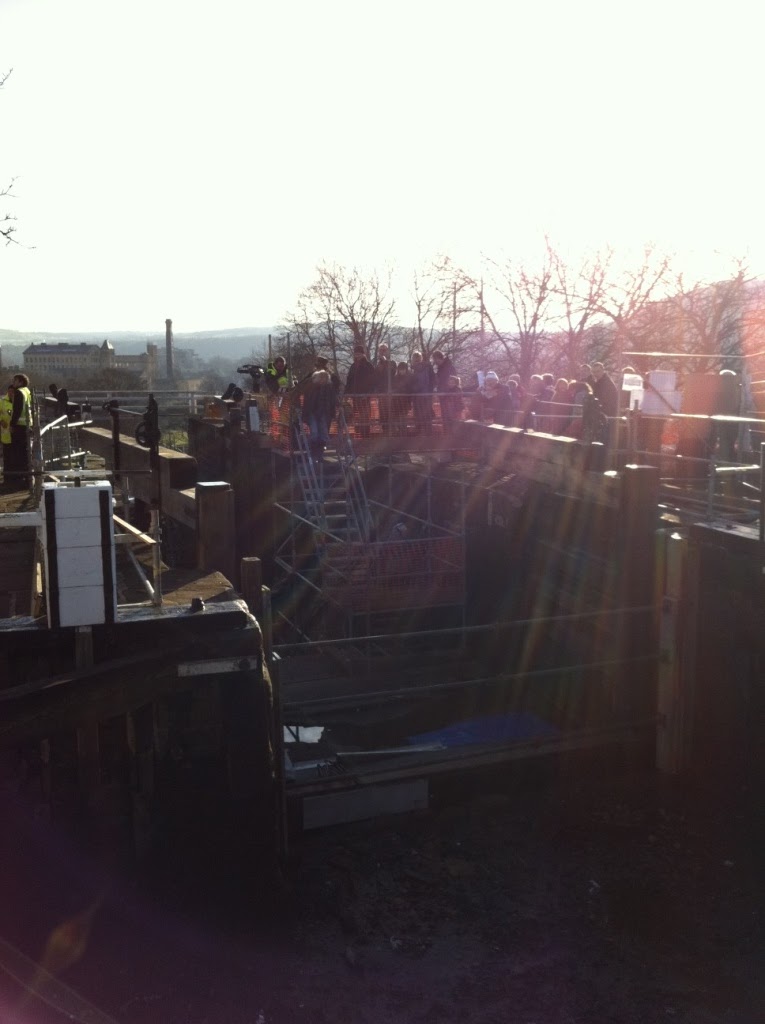
We arrived at about 2:00pm and made our way to the end of the queue that was snaking back over the swing bridge and up towards the Fairfax Road allotments. The queue was made up of a diverse range of people; families, ramblers, those with an interest in engineering or local history. Everyone chatted amiably and, with a few exceptions, nobody minded the wait. Several people commented on the numbers that had made the trip to see the locks and how the owners of the Five Rise cafe must have been looking forward to the best weekend of the year.

As the queue gradually moved forward (with more people arriving all the time) we overheard one of the renovation team on his mobile phone, "We're going to have to stay open a little later than planned...check with the volunteers that they can stay on after four..." How great that so much interest was being taken in our little piece of industrial heritage. Mini was certainly excited by the prospect of walking through the locks. "Will it be muddy?", she asked with a glint in her eye.
After 25 minutes or so we reached the head of the queue. As we carefully clambered down the first temporary staircase into the top lock chamber the scale of the project began to dawn. The water had been drained from the locks, and small pumps in each chamber were dealing with any seepage. Looking upstream, I could see the planks of wood laid one on top of the next to form a water-tight barrier. It seemed sturdy enough..."I hope so", said the cheerful volunteer who was stationed at this point, "It's all that is keeping back sixteen miles of canal!"

Once in the lock itself, you can really appreciate the skill of the craftsmen who were involved in the original building of the canal. Blocks of stone three feet wide, stretching up over ten meters above our heads. To one side was a hole in the wall big enough for mini to climb inside. This was one of the sluice outlets that help to fill the locks as they are required. Down here, awed by the sheer scale, it was easy to imagine the sheer hard work involved in digging out the channel, lining it and making it all function. All done, of course, with hand tools; you could almost hear the echoes of the pick axes and shovels.

We moved through the five locks and I cursed myself for not bringing my DSLR camera. Plenty of people had and were capturing the day both in stills and on video. Beneath one of the new gates we listened to another volunteer who was explaining about how they were made locally in one of only two workshops in the country capable of doing it. Each door is handmade to fit from English Green Oak and weighs five tonnes. With the weight of the water in the lock when they are operational, each door will weigh nearer twenty-five tonnes. The pairs of doors cost in the region of £25,000 to make and are expected to last up to thirty years. The top set they are replacing had lasted over forty years but with new regulations on the kinds of preservatives that can be used it is unlikely that these new ones will have as long a life.

Looking back up the flight of locks, I was really pleased that I had made the effort to come and see them from this unique perspective. Mini had been fascinated by the whole adventure, and this was a fantastic opportunity to experience some real living history.

As we climbed the staircase and stood on the side of the bottom lock, a small, tourist boat edged its way into the mouth of the lock for a close up look at the new gates. Mini waved at the passengers and squeezed my hand. "They can't walk inside it, can they?" she said. "No, but we have. Did you enjoy it?"
"Yeah!", she replied, "It was cool!...but not very muddy"
She seemed almost disappointed.
Wednesday, 28 December 2011
Home Tourist 3 - How Stean Gorge
Wanting a post-Christmas outing to blow away the cobwebs and work off a bit of the over-indulgence, the Monkeyclan decided to visit How Stean Gorge in Nidderdale. This part of the Yorkshire Dales is well-known for the spectacular scenery and geological wonders - there are caverns, river gorges and pot-holes aplenty. We wanted to get away from the city, into some nature, and have a scenic walk to stretch the legs. We got all that and more...

Situated 8 miles or so beyond the pretty Dales town of Pately Bridge, How Stean Gorge has been a visitor attraction since the Victorian era. The present owners have upgraded it considerably and it now offers outdoor adventure activities for families, schools groups, and even corporate training events. On our visit, on a slightly damp and drizzly late December day however, it was nice and quiet.
The drive from Pately Bridge takes you alongside the River Nidd for a fair distance before the immense expanse of Gouthwaite Reservoir appears. The reservoir is a Site of Special Scientific Interest, and home to a large number of bird species. There are several viewing areas along its shores that allow for a chance to observe the wildlife. This stretch of the road is very like those you find around the Lake District and the scenery is similar, with wooded slopes and rolling, heather strewn moorland above. Just beyond the attractive village of Lofthouse is the car-park and reception for How Stean Gorge. Slowly driving over the bridge to the car park gave our excited kids their forst glimpse of the gorge itself. Running for almost 1km in length and up to 20m deep in places, it is quite something.

The friendly receptionist welcomed us with a smile and, as she explained where to collect our hard hats and gave out the dynamo powered torches that we would need, she also pointed out the areas that could be slippery underfoot. At £16 for a family ticket (in our case two adults and three children) it is good value and certainly cheaper than a trip to the local cineplex. It is also way more fun!
We each took a hard hat from the bins at the entrance to the gorge and headed off along the path. This is not a suitable place for anyone with a pushchair or any mobility problems (although the cafe is wheelchair accessible) as the paths are uneven, narrow and follow the river's edge. The trail leads up river several metres above the river itself. From this vantage point it is easy to see the power of the water as it cascades through the narrow, limestone gorge. The rock has been eroded into twisting curves and the water froths and tumbles on its way downstream. The noise of the river echoes back and forth between the steep banks and adds to the atmosphere of adventure. We were only walking along the footpath and the adrenaline was flowing; it must be amazing to be scrambling and wading along the river itself, following the 'Via Ferrara' trail. This guided walk, wade, climb and abseil is bookable online and does look both exhilarating and terrifying in equal parts; especially as the safety lines, ariel ladders and walkways are clearly visible from the pathway. Needless to say, our fourteen year old son has requested that we book for him to go for his next birthday!

Today was to be rather more sedate although we did get to scramble along the river bank and feel the power of the water at close quarters. First, though, we headed along the trail to find Aslan. This carved wooden statue was apparently commissioned by Disney as promotion for the recent Chronicles of Narnia films, although quite how it ended up here is not entirely clear. Other information about the gorge is more forthcoming thanks to a series of information boards posted at regular intervals along the trail. These give historical, botanical and geological information as well as encouraging younger visitors to look out for various examples of wildlife and flora. At the end of the trail is How Stean Tunnel which provides some slightly more challenging terrain, with caves and rock formations to explore. Due to the high water levels we decided not to risk this particular section and, instead, headed back downstream towards Tom Taylor's Cave.
Crossing the gorge on one of the narrow beam footbridges, we made our way to the mouth of the Cave. Named after a local ne'er do well and highwayman, the cave is a 300ft tunnel under the river bank. Originally used by Tom Taylor as a hideout and store for his ill-gotten loot, this is a great first experience for a novice caver. Just inside the entrance to the cave, on the left, a rope allows access into a smaller chamber. It is a bit of a strenuous climb but well worth it. The main tunnel is entered via a wooden staircase. The passage is narrow and low at times (hence the hard hats!) but relatively easy going. Our five-year-old managed it and enjoyed using the torch she had been given to illuminate the rock formations and the sources of the water dropping from above. At the far end of the tunnel, as we had taken it, is 'the beehive chamber' and just beyond this a natural staircase leads upwards to emerge into daylight in 'Cat Hole' not far from the car park. It was here that Minimonkey was delighted to meet some of the local wildlife; a very cheeky and surprisingly confident robin came to investigate her boots.

We decided to make our way back through the cave to the river bank. Another narrow bridge took us across the river again to a long, low flat rock from which we skimmed stones and would probably have had our picnic had I not left it on the dining table at home. Instead we headed to the tearooms for a well-deserved cake and a cuppa. Having successfully navigated the river bank and twice through the cave, Minimonkey celebrated the end of her walk by having to be rescued from the top of the climbing frame in the small playground outside the cafe. The tearooms sell home-cooked food using locally sourced ingredients, as well as a selection of delicious cakes. I had never heard of it before but can heartily recommend the Jap. Once again the service was friendly and cheerful, and the lady in the cafe was very apologetic that there was nothing wheat or egg-free for Minimonkey to eat.
Feeling tired and happy, we chatted over our drinks and looked at the artworks by local artists that are displayed on the tearoom walls. Our favourite was the sculpture of a viking longboat made from retired stainless steel teapots and jugs from the cafe. After a quick visit to the loos and the obligatory stop at the small giftshop, we said goodbye and headed back in the fading daylight. Passing through the dusky countryside, seeing the Christmas lights in the houses of Lofthouse and Ramsgill, I turned to ask the Monkeykids what they had enjoyed most about the day...but they were all asleep in the back of the car.
Full details about How Stean Gorge can be found at their website.

Situated 8 miles or so beyond the pretty Dales town of Pately Bridge, How Stean Gorge has been a visitor attraction since the Victorian era. The present owners have upgraded it considerably and it now offers outdoor adventure activities for families, schools groups, and even corporate training events. On our visit, on a slightly damp and drizzly late December day however, it was nice and quiet.
The drive from Pately Bridge takes you alongside the River Nidd for a fair distance before the immense expanse of Gouthwaite Reservoir appears. The reservoir is a Site of Special Scientific Interest, and home to a large number of bird species. There are several viewing areas along its shores that allow for a chance to observe the wildlife. This stretch of the road is very like those you find around the Lake District and the scenery is similar, with wooded slopes and rolling, heather strewn moorland above. Just beyond the attractive village of Lofthouse is the car-park and reception for How Stean Gorge. Slowly driving over the bridge to the car park gave our excited kids their forst glimpse of the gorge itself. Running for almost 1km in length and up to 20m deep in places, it is quite something.

We each took a hard hat from the bins at the entrance to the gorge and headed off along the path. This is not a suitable place for anyone with a pushchair or any mobility problems (although the cafe is wheelchair accessible) as the paths are uneven, narrow and follow the river's edge. The trail leads up river several metres above the river itself. From this vantage point it is easy to see the power of the water as it cascades through the narrow, limestone gorge. The rock has been eroded into twisting curves and the water froths and tumbles on its way downstream. The noise of the river echoes back and forth between the steep banks and adds to the atmosphere of adventure. We were only walking along the footpath and the adrenaline was flowing; it must be amazing to be scrambling and wading along the river itself, following the 'Via Ferrara' trail. This guided walk, wade, climb and abseil is bookable online and does look both exhilarating and terrifying in equal parts; especially as the safety lines, ariel ladders and walkways are clearly visible from the pathway. Needless to say, our fourteen year old son has requested that we book for him to go for his next birthday!

Today was to be rather more sedate although we did get to scramble along the river bank and feel the power of the water at close quarters. First, though, we headed along the trail to find Aslan. This carved wooden statue was apparently commissioned by Disney as promotion for the recent Chronicles of Narnia films, although quite how it ended up here is not entirely clear. Other information about the gorge is more forthcoming thanks to a series of information boards posted at regular intervals along the trail. These give historical, botanical and geological information as well as encouraging younger visitors to look out for various examples of wildlife and flora. At the end of the trail is How Stean Tunnel which provides some slightly more challenging terrain, with caves and rock formations to explore. Due to the high water levels we decided not to risk this particular section and, instead, headed back downstream towards Tom Taylor's Cave.
Crossing the gorge on one of the narrow beam footbridges, we made our way to the mouth of the Cave. Named after a local ne'er do well and highwayman, the cave is a 300ft tunnel under the river bank. Originally used by Tom Taylor as a hideout and store for his ill-gotten loot, this is a great first experience for a novice caver. Just inside the entrance to the cave, on the left, a rope allows access into a smaller chamber. It is a bit of a strenuous climb but well worth it. The main tunnel is entered via a wooden staircase. The passage is narrow and low at times (hence the hard hats!) but relatively easy going. Our five-year-old managed it and enjoyed using the torch she had been given to illuminate the rock formations and the sources of the water dropping from above. At the far end of the tunnel, as we had taken it, is 'the beehive chamber' and just beyond this a natural staircase leads upwards to emerge into daylight in 'Cat Hole' not far from the car park. It was here that Minimonkey was delighted to meet some of the local wildlife; a very cheeky and surprisingly confident robin came to investigate her boots.

We decided to make our way back through the cave to the river bank. Another narrow bridge took us across the river again to a long, low flat rock from which we skimmed stones and would probably have had our picnic had I not left it on the dining table at home. Instead we headed to the tearooms for a well-deserved cake and a cuppa. Having successfully navigated the river bank and twice through the cave, Minimonkey celebrated the end of her walk by having to be rescued from the top of the climbing frame in the small playground outside the cafe. The tearooms sell home-cooked food using locally sourced ingredients, as well as a selection of delicious cakes. I had never heard of it before but can heartily recommend the Jap. Once again the service was friendly and cheerful, and the lady in the cafe was very apologetic that there was nothing wheat or egg-free for Minimonkey to eat.
Feeling tired and happy, we chatted over our drinks and looked at the artworks by local artists that are displayed on the tearoom walls. Our favourite was the sculpture of a viking longboat made from retired stainless steel teapots and jugs from the cafe. After a quick visit to the loos and the obligatory stop at the small giftshop, we said goodbye and headed back in the fading daylight. Passing through the dusky countryside, seeing the Christmas lights in the houses of Lofthouse and Ramsgill, I turned to ask the Monkeykids what they had enjoyed most about the day...but they were all asleep in the back of the car.
Full details about How Stean Gorge can be found at their website.
Sunday, 20 November 2011
The Soul of the City
This article originally appeared on the CultureVulture website.
There are some buildings that fulfil an important role in the fabric of people's lives. Depending on one's viewpoint and experience, a solid argument could be made for any number of buildings - churches, schools, hospitals, libraries etc. Indeed, architects would certainly argue that all buildings are important else why build them in the first place? However, there are some buildings which hold a more central place in people's affections; I can't imagine too much protest over the demolition of the local tax office.

In Bradford one such building is the old Odeon Cinema. Originally built in 1929, the imposing art deco building was, at one time, the third largest entertainment venue in the country, boasting a ballroom, restaurant and large-scale auditorium. In the 1960s it became part of the Gaumont circuit, attracting top names from the rock and pop world including Tom Jones, The Rolling Stones, and The Beatles. Famously, John Lennon found himself in need of a dentist whilst in Bradford, and nipped up Thotnton Road to attend a local surgery between the matinee and evening shows. A refit in the late 1960s covered up much of the Odeon's splendour but, thankfully, many of the original fixtures, features and fittings remain behind stud walls and breezeblocks. A detailed history of the building, along with images from its heyday can be found on the Bradford Odeon Rescue Group website.
This was the cinema where I first saw Star Wars, queuing around the block to get in. I saw The Spy Who Loved Me at the Odeon; saw my first 'A' rated film - we sneaked in to watch Kramer vs Kramer having paid to see Pete's Dragon. I was here when a cinema full of skinheads, scooter boys and rude girls moon stomped in the aisles as the film Dance Craze played on the screen. It was here that I saw Close Encounters of the Third Kind. It was here that I had my first close encounter of the teenage kind during a showing of Mannequin!
Even when the owners decided to maximise profit by splitting the big auditorium into two, then three smaller screens, the magic continued. When my wife and I first got together, some of our earliest dates were at The Odeon; we took our son to see The Tigger Movie, his first big-screen experience; all milestones in our family's shared history. These experiences are multiplied across the many tens of thousands of other Bradfordians who used to go to The Odeon.
The beautiful building remains, slowly rotting through neglect whilst around it other construction sites throw up modern glass and steel office blocks and anonymous chain hotels that literally reflect the shabbiness of this once great palace of entertainment. Just a few metres away across the busy dual carriageway that slices through the city centre, the City Park nears completion. This £24m development will give Bradford the largest city centre water feature in Europe. It comprises approximately six acres of paved and landscaped walkways that can be flooded and drained as required. More than a hundred controllable fountains will play, creating dynamic water sculptures, beneath the tall, reed-like floodlights that will illuminate the space at night.

Now, I am an optimistic person and can already see some benefits from the City Park development, not least of which is the opening up of the skyline across the Centenary Square. Now it is possible to look from the stunning Italianate City Hall building right across to The Alhambra Theatre. The Sixties brutalist home of The National Media Museum looks down from one side, whilst from the other stares the modern edifice of the Provident Financial building - several eras of architectural style collected together. But slap bang in the middle, like a derelict and decrepit dowager aunt, sits The Odeon. Incongruous, neglected, but, stubbornly, still there.
The Council have shown a woeful lack of vision regarding the Odeon. Where other cities would have capitalised on the architectural harmony between The Alhambra Theatre and the Odeon, creating a cultural quarter for the city like Sheffield has done, Bradford Council have hesitated and capitulated as property developers and private financiers have paraded one unwanted or unworkable scheme after another through the planning office. As everyone's attention was drawn to the ill-considered and ultimately ill-fated Westfield development planned for the site of the original Forster Square, the Odeon was quietly sold, only to be left to crumble. Very few Bradfordians actually thought we needed a new shopping centre (the Forster Square Retail Park - as soulless as it sounds - had driven a stake through the heart of the City's central shopping area already) but pretty much everyone who was asked or who offered their opinions wanted the Odeon to be saved.
So what happens to a city's collective memories and experiences once such a place is pulled down? And how do those people feel when their opinions are sought only to be ignored? When they have clearly expressed their wishes regarding the future of the building, through letters to the council, representations to English Heritage, and through a large-scale public demonstration of their support for it, and for all of that to be disregarded; what then?
There are some buildings that fulfil an important role in the fabric of people's lives. Depending on one's viewpoint and experience, a solid argument could be made for any number of buildings - churches, schools, hospitals, libraries etc. Indeed, architects would certainly argue that all buildings are important else why build them in the first place? However, there are some buildings which hold a more central place in people's affections; I can't imagine too much protest over the demolition of the local tax office.

In Bradford one such building is the old Odeon Cinema. Originally built in 1929, the imposing art deco building was, at one time, the third largest entertainment venue in the country, boasting a ballroom, restaurant and large-scale auditorium. In the 1960s it became part of the Gaumont circuit, attracting top names from the rock and pop world including Tom Jones, The Rolling Stones, and The Beatles. Famously, John Lennon found himself in need of a dentist whilst in Bradford, and nipped up Thotnton Road to attend a local surgery between the matinee and evening shows. A refit in the late 1960s covered up much of the Odeon's splendour but, thankfully, many of the original fixtures, features and fittings remain behind stud walls and breezeblocks. A detailed history of the building, along with images from its heyday can be found on the Bradford Odeon Rescue Group website.
This was the cinema where I first saw Star Wars, queuing around the block to get in. I saw The Spy Who Loved Me at the Odeon; saw my first 'A' rated film - we sneaked in to watch Kramer vs Kramer having paid to see Pete's Dragon. I was here when a cinema full of skinheads, scooter boys and rude girls moon stomped in the aisles as the film Dance Craze played on the screen. It was here that I saw Close Encounters of the Third Kind. It was here that I had my first close encounter of the teenage kind during a showing of Mannequin!
Even when the owners decided to maximise profit by splitting the big auditorium into two, then three smaller screens, the magic continued. When my wife and I first got together, some of our earliest dates were at The Odeon; we took our son to see The Tigger Movie, his first big-screen experience; all milestones in our family's shared history. These experiences are multiplied across the many tens of thousands of other Bradfordians who used to go to The Odeon.
The beautiful building remains, slowly rotting through neglect whilst around it other construction sites throw up modern glass and steel office blocks and anonymous chain hotels that literally reflect the shabbiness of this once great palace of entertainment. Just a few metres away across the busy dual carriageway that slices through the city centre, the City Park nears completion. This £24m development will give Bradford the largest city centre water feature in Europe. It comprises approximately six acres of paved and landscaped walkways that can be flooded and drained as required. More than a hundred controllable fountains will play, creating dynamic water sculptures, beneath the tall, reed-like floodlights that will illuminate the space at night.

Now, I am an optimistic person and can already see some benefits from the City Park development, not least of which is the opening up of the skyline across the Centenary Square. Now it is possible to look from the stunning Italianate City Hall building right across to The Alhambra Theatre. The Sixties brutalist home of The National Media Museum looks down from one side, whilst from the other stares the modern edifice of the Provident Financial building - several eras of architectural style collected together. But slap bang in the middle, like a derelict and decrepit dowager aunt, sits The Odeon. Incongruous, neglected, but, stubbornly, still there.
The Council have shown a woeful lack of vision regarding the Odeon. Where other cities would have capitalised on the architectural harmony between The Alhambra Theatre and the Odeon, creating a cultural quarter for the city like Sheffield has done, Bradford Council have hesitated and capitulated as property developers and private financiers have paraded one unwanted or unworkable scheme after another through the planning office. As everyone's attention was drawn to the ill-considered and ultimately ill-fated Westfield development planned for the site of the original Forster Square, the Odeon was quietly sold, only to be left to crumble. Very few Bradfordians actually thought we needed a new shopping centre (the Forster Square Retail Park - as soulless as it sounds - had driven a stake through the heart of the City's central shopping area already) but pretty much everyone who was asked or who offered their opinions wanted the Odeon to be saved.
So what happens to a city's collective memories and experiences once such a place is pulled down? And how do those people feel when their opinions are sought only to be ignored? When they have clearly expressed their wishes regarding the future of the building, through letters to the council, representations to English Heritage, and through a large-scale public demonstration of their support for it, and for all of that to be disregarded; what then?
Tuesday, 16 August 2011
Sense After All The Nonsense
The tumultuous events of last week that saw first London and then other major cities erupt into violent disorder gave many people grave cause for concern. In the aftermath there has been much proselytising and hand-wringing, with the politicians desperate to make capital out of the events. There has been much written about the causes for the riots, and many socio-political theories about the looting; some of the articles have been incisive, each making valid points that I don't intend to regurgitate here. Suffice it to say that I will only offer my thoughts and opinions in order to generate debate and discussion. My theme, as often, is responsibility.
There were many young people who were involved in the disturbances who could give no credible justification for their actions. They were just caught up in 'the buzz' of the events. There were some who claimed it was an attack on "the rich" and to show "the Government that we can do what we want" - although when pressed they were not able to say exactly which party were in power. We can laugh at their ignorance or be disgusted by their lack of respect but these comments (amid a raft of others carried by the news channels) are indicative of a number of the issues that have lead to the situation where such riots can take place.
To have our young people so disengaged from mainstream politics - the kind with a small 'p' as well as the national arena - has left them with no stake in their communities. They do not engage therefore they do not care. One of the reasons, perhaps, that they do not engage is because no-one listens to them anyway. Politicians and policy makers pay lip-service to young people's concerns in the same way that they do those of the elderly or with disabilities. These groups are used as causes to hang careers on, and to score points against the opposition. A very clear example of this occurred on the BBC Newsnight programme broadcast last Thursday (11th August)
The producers has convened a discussion panel that included a young, black man, Margaret Costello who campaigns on behalf of the victims of crime, a rapper called 'Reveal', and Kelvin MacKenzie, ex-editor of The Sun newspaper. Whenever the young man was asked a question and began to answer it, within seconds of him starting to talk the two older people talked over his answers, did not let him finish a sentence, objected to his arguments or contradicted his opinions. This happened consistently throughout the segment. In the end, the young man just sat with a resigned and bemused expression on his face whilst Kelvin MacKenzie went apoplectic beside him.
The irony was that the young man (whose name I really should have taken note of) was stating that many young people are disaffected and disenfranchised precisely because their views are not sought or, if they are, they are not listened to. The point was eloquently made by the actions of the two older and, one would have hoped, wiser panellists.
So, yes, those involved in the anti-social, disruptive and criminal behaviour must take responsibility for their actions. They must repay the debt to their communities, without question. But maybe the number of those involved might have been smaller had people been more prepared to listen to the concerns and opinions of those who feel cut-off from mainstream society.
We owe it to our young people to value them enough to let them express themselves. It is our responsibility to teach them how to do that. Young people, especially adolescents, are self-absorbed and introspective; that is the developmental stage that they are at. Much of what they will have to say will reflect this and may well strike us as ego-centric or naive. But in there might be some truths that we need to hear. They may well be uncomfortable truths too about how we are failing to support our future generations.
There were many young people who were involved in the disturbances who could give no credible justification for their actions. They were just caught up in 'the buzz' of the events. There were some who claimed it was an attack on "the rich" and to show "the Government that we can do what we want" - although when pressed they were not able to say exactly which party were in power. We can laugh at their ignorance or be disgusted by their lack of respect but these comments (amid a raft of others carried by the news channels) are indicative of a number of the issues that have lead to the situation where such riots can take place.
To have our young people so disengaged from mainstream politics - the kind with a small 'p' as well as the national arena - has left them with no stake in their communities. They do not engage therefore they do not care. One of the reasons, perhaps, that they do not engage is because no-one listens to them anyway. Politicians and policy makers pay lip-service to young people's concerns in the same way that they do those of the elderly or with disabilities. These groups are used as causes to hang careers on, and to score points against the opposition. A very clear example of this occurred on the BBC Newsnight programme broadcast last Thursday (11th August)
The producers has convened a discussion panel that included a young, black man, Margaret Costello who campaigns on behalf of the victims of crime, a rapper called 'Reveal', and Kelvin MacKenzie, ex-editor of The Sun newspaper. Whenever the young man was asked a question and began to answer it, within seconds of him starting to talk the two older people talked over his answers, did not let him finish a sentence, objected to his arguments or contradicted his opinions. This happened consistently throughout the segment. In the end, the young man just sat with a resigned and bemused expression on his face whilst Kelvin MacKenzie went apoplectic beside him.
The irony was that the young man (whose name I really should have taken note of) was stating that many young people are disaffected and disenfranchised precisely because their views are not sought or, if they are, they are not listened to. The point was eloquently made by the actions of the two older and, one would have hoped, wiser panellists.
So, yes, those involved in the anti-social, disruptive and criminal behaviour must take responsibility for their actions. They must repay the debt to their communities, without question. But maybe the number of those involved might have been smaller had people been more prepared to listen to the concerns and opinions of those who feel cut-off from mainstream society.
We owe it to our young people to value them enough to let them express themselves. It is our responsibility to teach them how to do that. Young people, especially adolescents, are self-absorbed and introspective; that is the developmental stage that they are at. Much of what they will have to say will reflect this and may well strike us as ego-centric or naive. But in there might be some truths that we need to hear. They may well be uncomfortable truths too about how we are failing to support our future generations.
Saturday, 6 August 2011
Home Tourist 2 - The Leeds Owl Trail
Yesterday my two daughters and I braved the rain and headed to Leeds in order to find some owls. When I posted a message on my twitter account that we were going on the Owl Trail, a friend who lives in London asked, "What, pray tell, is the Leeds Owl Trail?". When I explained that it wasn't, in fact, some huge aviary dedicated to owls but rather a semi guided walk through Leeds city centre, in the course of which you search for statues, carvings, pictures and other representations of owls, his reply was, "Genius!" And it is...
Finding activities suitable for a ten year old and a five year old to enjoy that caters for both ages, is interactive, outdoors and (best of all) free is not an easy task but I remembered seeing the leaflet for the Leeds Owl Trail in the tourist information centre at Leeds Station on a previous visit, and thought that we would give it a go. So, having more or less convinced the two monkeys that they would enjoy the day, we set out.
Minimonkey (5 going on 30) took some drawing paper, pencils and a word search book with her "in case I get bored and need a sit down" - these all made an appearance on the short train journey between Bingley and Leeds but were not seen again all afternoon. The word search book was, I soon realised, just a cunning ploy to get her little hands on the highlighter pen that I have in my bag and keep it for the day in order to mark on the map the locations of any owls we might discover on our quest. Midimonkey (10 going on 35) took the Harry Potter book that she is re-reading for the second time. I think she was secretly hoping that Hedwig might put in a suprise appearance during the day.
We picked up the leaflet in the tourist information shop and had a quick pre-expedition study of the terrain. The graphical representation of the city centre is colourful and engaging, with photographs of the owls you need to spot and a brief statement about each one placed around the edges. There is a good deal of information squeezed onto the leaflet and our recce soon revealed that there were several owls to find quite near to the station. So, takng a rather carefree approach, we fastened up our raincoats and headed off in search of owl number 17.
This is one of the strengths of the trail, it can be followed in a number of ways: start with owl number 1 and work your way through all twenty five of them, pick a random number and try to find it, take the i-Spy book approach and just tick them off as you go about your business (no points awarded for finding them, though, in this case!) We found the first owl and were away. It soon became clear that the trail combines social history, architecture, folk-lore and art in a way that encourages visitors to Leeds to take a closer look around them. I am sure that other cities have something in a similar vein but having the owl theme just gives this experience a little something extra.
By the time we had ticked off owls number 16, 14 and 15 the girls were hooked. "This is really good fun, Dad!" Mini exclaimed as she spotted the carved owl on Hepper House (no.13). "It's more fun than I thought it was going to be." Midi agreed. We stood just inside the entrance of the posh hotel that now houses the Quebec Owl, dripping quietly onto the expensive carpet whilst gazing up at the elaborate and beautiful stained glass window. Nobody seemed to mind the bedraggled trio who clearly were not guests. Perhaps they were used to 'owl tourists'? We made up our own 'Owl Detectives' theme tune and sang it as we went round. We even searched in the style of action heroes, making dramatic pointing gestures and running across Millenium Square in slow-motion. On reaching the large golden owls outside the Civic Hall, however, Midi had noticed that some people were staring and mumbled, "Okay Dad, that's enough, you're embarrassing me now!" Ah, lost innocence...
In a calmer manner we carried on searching for the owls, learning along the way the different materials that were used for the buildings, the architects' names, the predominant style in which the buildings were built. Midi read the map and lead the way, Mini coloured in the finds with the highlighter, and I had a lovely afternoon with my daughters. The rain stopped and the sun came out, illuminating the stones of St Anne's Cathedral. Mini declared that she was tired and needed a chai tea in Starbucks (her mother's daughter, definitely) and so we called it a day. Over a warm drink we chatted about the day; both girls had enjoyed the experience. Midi had liked the historical aspect of the trail, finding out about the City itself. Mini had liked finding the different types of owls and drew a picture of several on the paper she had brought with her. We had found twelve of the twenty-five owls on the trail - although technically we had discovered thirteen as there is one above the door to the old post office in City Square that does not currently appear on the list - and will definitely come back to find the remainder.
On the whole, the Leeds Owl Trail is a winner for anyone, either with or without kids, who is interested in architecture, history and art, and wants a novel way to discover the heritage of Leeds City Centre. It is fairly easy walking with no great distances involved, Leeds Parish Church being the current furthest point from the train station. The roads around King Street, Quebec Street, East Parade, The Headrow, and Park Row are busy and care should be taken when crossing them, especially with an energetic five-year-old! Drivers seem to care little for pedestrians, owl-hunters or no, as evidenced by the taxi driver who took great pleasure in driving through a huge puddle, soaking some poor young chap in a suit who looked like he was on his way to a meeting. So, if you do decide to follow the recommendation of a flawed monkey and two of the monkeykids, we hope you enjoy spotting the Leeds owls. For more information log on to http://www.leedsowltrail.com/
Now, how do you get bright yellow ink off of monkey paws? Mini, come here...!
Finding activities suitable for a ten year old and a five year old to enjoy that caters for both ages, is interactive, outdoors and (best of all) free is not an easy task but I remembered seeing the leaflet for the Leeds Owl Trail in the tourist information centre at Leeds Station on a previous visit, and thought that we would give it a go. So, having more or less convinced the two monkeys that they would enjoy the day, we set out.
Minimonkey (5 going on 30) took some drawing paper, pencils and a word search book with her "in case I get bored and need a sit down" - these all made an appearance on the short train journey between Bingley and Leeds but were not seen again all afternoon. The word search book was, I soon realised, just a cunning ploy to get her little hands on the highlighter pen that I have in my bag and keep it for the day in order to mark on the map the locations of any owls we might discover on our quest. Midimonkey (10 going on 35) took the Harry Potter book that she is re-reading for the second time. I think she was secretly hoping that Hedwig might put in a suprise appearance during the day.
We picked up the leaflet in the tourist information shop and had a quick pre-expedition study of the terrain. The graphical representation of the city centre is colourful and engaging, with photographs of the owls you need to spot and a brief statement about each one placed around the edges. There is a good deal of information squeezed onto the leaflet and our recce soon revealed that there were several owls to find quite near to the station. So, takng a rather carefree approach, we fastened up our raincoats and headed off in search of owl number 17.
This is one of the strengths of the trail, it can be followed in a number of ways: start with owl number 1 and work your way through all twenty five of them, pick a random number and try to find it, take the i-Spy book approach and just tick them off as you go about your business (no points awarded for finding them, though, in this case!) We found the first owl and were away. It soon became clear that the trail combines social history, architecture, folk-lore and art in a way that encourages visitors to Leeds to take a closer look around them. I am sure that other cities have something in a similar vein but having the owl theme just gives this experience a little something extra.
By the time we had ticked off owls number 16, 14 and 15 the girls were hooked. "This is really good fun, Dad!" Mini exclaimed as she spotted the carved owl on Hepper House (no.13). "It's more fun than I thought it was going to be." Midi agreed. We stood just inside the entrance of the posh hotel that now houses the Quebec Owl, dripping quietly onto the expensive carpet whilst gazing up at the elaborate and beautiful stained glass window. Nobody seemed to mind the bedraggled trio who clearly were not guests. Perhaps they were used to 'owl tourists'? We made up our own 'Owl Detectives' theme tune and sang it as we went round. We even searched in the style of action heroes, making dramatic pointing gestures and running across Millenium Square in slow-motion. On reaching the large golden owls outside the Civic Hall, however, Midi had noticed that some people were staring and mumbled, "Okay Dad, that's enough, you're embarrassing me now!" Ah, lost innocence...
 |
| The Monkeygirls on the Owl Trail |
In a calmer manner we carried on searching for the owls, learning along the way the different materials that were used for the buildings, the architects' names, the predominant style in which the buildings were built. Midi read the map and lead the way, Mini coloured in the finds with the highlighter, and I had a lovely afternoon with my daughters. The rain stopped and the sun came out, illuminating the stones of St Anne's Cathedral. Mini declared that she was tired and needed a chai tea in Starbucks (her mother's daughter, definitely) and so we called it a day. Over a warm drink we chatted about the day; both girls had enjoyed the experience. Midi had liked the historical aspect of the trail, finding out about the City itself. Mini had liked finding the different types of owls and drew a picture of several on the paper she had brought with her. We had found twelve of the twenty-five owls on the trail - although technically we had discovered thirteen as there is one above the door to the old post office in City Square that does not currently appear on the list - and will definitely come back to find the remainder.
On the whole, the Leeds Owl Trail is a winner for anyone, either with or without kids, who is interested in architecture, history and art, and wants a novel way to discover the heritage of Leeds City Centre. It is fairly easy walking with no great distances involved, Leeds Parish Church being the current furthest point from the train station. The roads around King Street, Quebec Street, East Parade, The Headrow, and Park Row are busy and care should be taken when crossing them, especially with an energetic five-year-old! Drivers seem to care little for pedestrians, owl-hunters or no, as evidenced by the taxi driver who took great pleasure in driving through a huge puddle, soaking some poor young chap in a suit who looked like he was on his way to a meeting. So, if you do decide to follow the recommendation of a flawed monkey and two of the monkeykids, we hope you enjoy spotting the Leeds owls. For more information log on to http://www.leedsowltrail.com/
Now, how do you get bright yellow ink off of monkey paws? Mini, come here...!
Sunday, 10 July 2011
Stop the Press! Final Edition
So, after more than 160 years, The News of the World publishes its last edition today. I shall not mourn its passing, but neither shall I celebrate, instead I shall let all the column inches, blog posts and commentators chronicle the sad and sorry end to a tale of moral bankruptcy and craven capitalism.
Much has been made already in the media about the hacking of private telephone calls in order to elicit information, and there is not much more to say except that the incidents currently under investigation illustrate all too clearly that we have, as a society, lost our way. That it happened at all is shameful enough but that the people ultimately responsible have remained in their (well-paid) jobs is scandalous. It is to be hoped that soon even they shall have to face the consequences of their actions.
I read somewhere this week that the hounding and eventual killing of The News of the World was a middle-class witch-hunt; that those calling for its demise were somehow depriving the working classes of a significant factor in their everyday lives. I found the opinion to be risible and offensive, assuming as it does that the working class don't deserve any better than endless celebrity gossip, xenophobia and mysogyny. Heaven forbid that the proles should educate themselves and question the status quo...
...Heaven may, indeed, forbid it seeing as the Church of England has a significant stake in News International, the Murdoch-owned parent organisation of the bastard child that is The News of the World. I knew that the Tory party were in bed with Murdoch, and that Tony Blair had indulged in some political 'romping' (as the paper in question may have put it) but I was shocked to learn that the CoE were the third part of the threesome! Greedy politicians and corrupt clergy were so often the target of the "investigative journalism" carried out - evidently by a private detective - by the News of the World. Ironic, then, that the two pillars of our Establishment should be so in thrall to its owner.
I also find it hard to believe that there are now hundreds, if not thoudands, of paedophiles, asylum seekers, cheating footballers, benefit fraudsters, and corrupt politicians across the country currently celebrating their luck. The News of the World may have broken the occasional story but it is hardly the moral guardian of the country, as a quick look at some of the headlines in the image below will testify.
![]()
So it will not be a black day for British journalism, and we know the vacuum left behind will soon be filled with another Murdoch-owned title - The Sun on Sunday being the most likely candidate. The whole 'affair' has quickly become a meta-media event as journalists from one paper write the obituary of another one. But the outcome of this week's events could spell the beginning of a brighter future where we are presented with all the facts, and one all-powerful Media Mogul does not wield so much influence over Church and State.
And don't feel too sorry for the journalists who have lost their jobs...I read somewhere that the unemployed live in five-bedroomed houses and earn £50K a year.
Much has been made already in the media about the hacking of private telephone calls in order to elicit information, and there is not much more to say except that the incidents currently under investigation illustrate all too clearly that we have, as a society, lost our way. That it happened at all is shameful enough but that the people ultimately responsible have remained in their (well-paid) jobs is scandalous. It is to be hoped that soon even they shall have to face the consequences of their actions.
I read somewhere this week that the hounding and eventual killing of The News of the World was a middle-class witch-hunt; that those calling for its demise were somehow depriving the working classes of a significant factor in their everyday lives. I found the opinion to be risible and offensive, assuming as it does that the working class don't deserve any better than endless celebrity gossip, xenophobia and mysogyny. Heaven forbid that the proles should educate themselves and question the status quo...
...Heaven may, indeed, forbid it seeing as the Church of England has a significant stake in News International, the Murdoch-owned parent organisation of the bastard child that is The News of the World. I knew that the Tory party were in bed with Murdoch, and that Tony Blair had indulged in some political 'romping' (as the paper in question may have put it) but I was shocked to learn that the CoE were the third part of the threesome! Greedy politicians and corrupt clergy were so often the target of the "investigative journalism" carried out - evidently by a private detective - by the News of the World. Ironic, then, that the two pillars of our Establishment should be so in thrall to its owner.
I also find it hard to believe that there are now hundreds, if not thoudands, of paedophiles, asylum seekers, cheating footballers, benefit fraudsters, and corrupt politicians across the country currently celebrating their luck. The News of the World may have broken the occasional story but it is hardly the moral guardian of the country, as a quick look at some of the headlines in the image below will testify.

So it will not be a black day for British journalism, and we know the vacuum left behind will soon be filled with another Murdoch-owned title - The Sun on Sunday being the most likely candidate. The whole 'affair' has quickly become a meta-media event as journalists from one paper write the obituary of another one. But the outcome of this week's events could spell the beginning of a brighter future where we are presented with all the facts, and one all-powerful Media Mogul does not wield so much influence over Church and State.
And don't feel too sorry for the journalists who have lost their jobs...I read somewhere that the unemployed live in five-bedroomed houses and earn £50K a year.
Wednesday, 30 March 2011
The Mill - City of Dreams
The following post is a slightly revised version of a piece that was originally submitted to The Culture Vulture website.
The huge, iron, gate clanks shut behind me as I walk into the cobbled yard outside the Mill. It is eerily still and quiet here now, sheltered in a patch of spring sunshine. My guide and I walk round the corner of the vast building, the chimney towering above us. Soon we step into the cool dark of the building itself and there is a scale model of the local area, cleverly constructed from record cards and archive boxes that had been discarded in the mill when it closed.
Through a red metal sliding door and we are in one of the huge loom sheds that once thundered with the sound of machinery, so loud that the workers had to learn to lip-read. Today, though, the silence settles like the dust and our footsteps echo as we walk between the pillars; woollen threads linking some of them, almost like a web.
Another metal door, this time green, leads us into a much smaller space about the size of a shipping container. Cardboard boxes and pallets line one wall and the plastic hood of a long-gone telephone booth hangs on the other. ‘I’m a Daily Star’ says the faded sticker next to it, yet more detritus left behind. Out again into a larger room, this time divided by industrial plastic curtains, and we find lengths of material draped from the roof beams, reminiscent of the weaving looms that are now conspicuous by their absence. A voice echoes from somewhere on another floor above and we turn at the sound. A set of metal lockers, a chair, a radio, a pair of polished shoes placed in the space suddenly bring a very human touch to this industrial landscape. Not only was this someone’s workplace, it was their life.
We pass a bicycle chained to the wall as we weave through narrow corridors flanked by empty offices. Only, like the rest of the mill, they are not quite empty. Reminders of the previous occupants and remnants of their routines remain; a flyblown calendar, a single office chair, a filing cabinet with one drawer left open a fraction. Quietly at first I can hear them at work, on the telephone, discussing orders, negotiating delivery times. Soon my imagination is filled with the clacking of typewriters tapping out the hi-hat rhythm above the mill’s bass drum thud of the looms. The corridors and stairwells whisper the secrets of office girls. Outside a shire horse stamps its iron-shod hooves on the cobbles and impatiently snorts in the dawn.
“It is this way, up the stairs, to The Ship”, says my guide, pulling me back into the here and now. I don’t have time to ask why there is a part of a textile mill called The Ship before I can see for myself. Stretching out for almost the full length of the mill building is a huge room. Curved beams like the timbers of a ship hold up the roof. More threads hang from the ceiling attached to big wooden bobbins and reels. Threads stretching back through time, linking us to the past, the past of this great building in this once great city.
A faded map of the world, the size of one wall hangs at the far end. It is out of date and some of the place names have been changed in recent times but many remain familiar. India, Ireland, Italy, Jamaica, Latvia, Poland, The Ukraine, Kashmir, Bangladesh. From all of these places people came to work in the mill. They brought their skills in spinning, weaving, dyeing, burling and mending. They brought their hopes and ambitions too; adding their own particular threads to be woven with all the others to make up the fabric of the city of dreams.
Freedom Studios have brought together an exciting and innovative creative team to work on this project. Directors Madani Younis and OmarElerian have worked with a small company of actors to research, recreate and retell some of the hundreds of stories collected in interviews with ex-millworkers. Award winning sound artist Janek Schaefer has created an evocative soundscape pieced together from the noises of machinery, electronics and the ambience of the building itself. He has even built a music-box that plays a melody created by the punched cards that once programmed the looms. Leeds-based light artists Lumen have constructed installations and projections and the production has been designed by Roma Patel.
Local people themselves are involved as a community cast of thirty actors will help to populate the vast open spaces of Drummonds Mill, and a crew of volunteers will help to guide the audience around the building during the performances.
 |
| Drummonds Mill Yard |
The huge, iron, gate clanks shut behind me as I walk into the cobbled yard outside the Mill. It is eerily still and quiet here now, sheltered in a patch of spring sunshine. My guide and I walk round the corner of the vast building, the chimney towering above us. Soon we step into the cool dark of the building itself and there is a scale model of the local area, cleverly constructed from record cards and archive boxes that had been discarded in the mill when it closed.
 |
| The Model Made of Record Cards |
Through a red metal sliding door and we are in one of the huge loom sheds that once thundered with the sound of machinery, so loud that the workers had to learn to lip-read. Today, though, the silence settles like the dust and our footsteps echo as we walk between the pillars; woollen threads linking some of them, almost like a web.
 |
| The Loom Shed |
Another metal door, this time green, leads us into a much smaller space about the size of a shipping container. Cardboard boxes and pallets line one wall and the plastic hood of a long-gone telephone booth hangs on the other. ‘I’m a Daily Star’ says the faded sticker next to it, yet more detritus left behind. Out again into a larger room, this time divided by industrial plastic curtains, and we find lengths of material draped from the roof beams, reminiscent of the weaving looms that are now conspicuous by their absence. A voice echoes from somewhere on another floor above and we turn at the sound. A set of metal lockers, a chair, a radio, a pair of polished shoes placed in the space suddenly bring a very human touch to this industrial landscape. Not only was this someone’s workplace, it was their life.
 |
| The Human Touch |
We pass a bicycle chained to the wall as we weave through narrow corridors flanked by empty offices. Only, like the rest of the mill, they are not quite empty. Reminders of the previous occupants and remnants of their routines remain; a flyblown calendar, a single office chair, a filing cabinet with one drawer left open a fraction. Quietly at first I can hear them at work, on the telephone, discussing orders, negotiating delivery times. Soon my imagination is filled with the clacking of typewriters tapping out the hi-hat rhythm above the mill’s bass drum thud of the looms. The corridors and stairwells whisper the secrets of office girls. Outside a shire horse stamps its iron-shod hooves on the cobbles and impatiently snorts in the dawn.
“It is this way, up the stairs, to The Ship”, says my guide, pulling me back into the here and now. I don’t have time to ask why there is a part of a textile mill called The Ship before I can see for myself. Stretching out for almost the full length of the mill building is a huge room. Curved beams like the timbers of a ship hold up the roof. More threads hang from the ceiling attached to big wooden bobbins and reels. Threads stretching back through time, linking us to the past, the past of this great building in this once great city.
 |
| The Ship |
A faded map of the world, the size of one wall hangs at the far end. It is out of date and some of the place names have been changed in recent times but many remain familiar. India, Ireland, Italy, Jamaica, Latvia, Poland, The Ukraine, Kashmir, Bangladesh. From all of these places people came to work in the mill. They brought their skills in spinning, weaving, dyeing, burling and mending. They brought their hopes and ambitions too; adding their own particular threads to be woven with all the others to make up the fabric of the city of dreams.
Freedom Studios have brought together an exciting and innovative creative team to work on this project. Directors Madani Younis and OmarElerian have worked with a small company of actors to research, recreate and retell some of the hundreds of stories collected in interviews with ex-millworkers. Award winning sound artist Janek Schaefer has created an evocative soundscape pieced together from the noises of machinery, electronics and the ambience of the building itself. He has even built a music-box that plays a melody created by the punched cards that once programmed the looms. Leeds-based light artists Lumen have constructed installations and projections and the production has been designed by Roma Patel.
 |
| Bobbins |
Local people themselves are involved as a community cast of thirty actors will help to populate the vast open spaces of Drummonds Mill, and a crew of volunteers will help to guide the audience around the building during the performances.
Saturday, 26 February 2011
Home Tourist - Jerusalem Farm
#HomeTourist is another great idea to have found popularity on Twitter. The idea is simple; in these straightened times, why spend money travelling to far flung places when you can rediscover the exoticly familiar on your own doorstep. It is always good to stop and re-evaluate what you have, to look at things afresh, and see things with new eyes. It was just this impulse (plus a little inspiration from the twitterverse) that took the family to Jerusalem Farm.
Hidden away in one of the many secluded valleys of Calderdale, Jerusalem Farm is a small piece of heaven not far from the bustling and creative town of Hebden Bridge. We drove up the winding road from Luddenden marvelling at the scenery. The houses clinging to the hillsides, huddled together for companionship, their small gardens looking like a rumpled patchwork quilt of colour amongst the dark stone buildings. This is no journey for the faint-hearted and drivers of a nervous disposition may well baulk at the thought of hairpin bends and single lane roads. We talked of how remote this area must feel in the winter when these tiny roads must surely become impassable. However, on an early Spring day, we had no such cause to worry.
Jerusalem Farm is a favourite spot for walkers, both with and without their dogs, and it is soon easy to see why. Once you walk down from the car park you can see the river valley stretching out in front of you. A fair proportion of the valley bottom is given over to a basic campsite (no electric hook-ups, communal shower blocks or patrons' bar here) but this doesn't open until Easter. It does get busy at weekends in the summer but we have it on good authority that it can be quieter during the week. The kids made a bee-line straight for the adventure playground before we all took a very pleasant walk along the river bank.
 The crystal clear water sparkled in the bright sunshine as it ran between the rocks providing a perfect white-water slalom for the stick and twig boats that we made. The river, though barely more than a brook at this point, runs quite quickly and so smaller adventurers are best supervised, but for older children there is plenty of scope for paddling, dam-building and river walking.
As we carried on up the valley we passed the man-made 'river-steps' (as our youngest christened the weir) before bearing left into the woods. Here we discovered a natural amphitheatre bounded by logs and home to some great, carved chairs. A norse-like wooden warrior guards the path, lending the clearing a vaguely Tolkein air. Our imaginative (not to say theatrical) troupe were soon recreating mythic battles with armies of goblins, stopping only to investigate some wondrous fungi growing on the logs. If nature is your thing, then this place has much to offer. We watched a pair of birds flitting about in the trees, building their nest. A kindly lady out walking her dog stopped to chat and the kids took advantage of the opportunity to make a fuss of the dog. A little way further on and we were walking up above the river again along a rather narrow footpath.
Hidden away in one of the many secluded valleys of Calderdale, Jerusalem Farm is a small piece of heaven not far from the bustling and creative town of Hebden Bridge. We drove up the winding road from Luddenden marvelling at the scenery. The houses clinging to the hillsides, huddled together for companionship, their small gardens looking like a rumpled patchwork quilt of colour amongst the dark stone buildings. This is no journey for the faint-hearted and drivers of a nervous disposition may well baulk at the thought of hairpin bends and single lane roads. We talked of how remote this area must feel in the winter when these tiny roads must surely become impassable. However, on an early Spring day, we had no such cause to worry.
 |
| The view towards the campsite |
 The crystal clear water sparkled in the bright sunshine as it ran between the rocks providing a perfect white-water slalom for the stick and twig boats that we made. The river, though barely more than a brook at this point, runs quite quickly and so smaller adventurers are best supervised, but for older children there is plenty of scope for paddling, dam-building and river walking.
  |
| The river offers lots of play potential |
 |
| The woodland walk |
Winding our way along here, the beauty and tranquility of the valley worked its magic and we slowed right down to dawdle in the sunshine. In the hour or so that we had been at Jerusalem Farm we had only seen a handful of other people. A lone walker, map in hand, passed as we played 'pooh-sticks' from the wooden bridge that marked the turning point for our walk. A man and his dog ran by but had time, as they slowed to cross the bridge, to make conversation. "Cracking day", he said. "I've got to be at work at half-four but I couldn't miss out on a day like today" and on they ran, back to their car and the everyday routine.
 |
| Nature lovers will love it here |
Our own return journey took us along the valley bottom to the stone bridge that marks the end of the camping ground. We stood and watched the vapour trails criss-cross the blue sky, listening to the river sounds before strolling up the hill to the car park. If it all sounds idyllic then I'm glad to confirm that it was. A lovely, family day-out that had cost us nothing but our time. As we drove back down the narrow roads towards Luddenden, bound for Hebden Bridge and the traditional family 'teas and wees' stop, I couldn't help but steal a line fromWilliam Blake and note that Jerusalem had indeed been 'builded here in England's green and pleasant land'
Details of Jerusalem Farm can be found here.
Tuesday, 22 February 2011
Inspiration - A cogitation
"Who are the people who you find inspirational?" was one of several questions recently posed on twitter. It is a deceptively simple question and should have been easy to answer. It isn't simple and wasn't easy. The thread in question (if you will excuse the pun) concerned itself not with the obvious candidates; Dr Martin Luther King, Gandhi, Nelson Mandela, JFK - although they are all, undeniably, inspirational figures - but rather with those people who galvanise local communities, provoke action, 'get things done'. I know quite a few dynamic and active people from several walks of life who could be described in those terms but it was in the thinking about the question that I came to a realisation that the inspiration comes from within the communities themselves. I'm not just referring to communities of people living in a particular area but also to communities of practice; artists, business-people, thinkers.
Certainly, there are those that act as figureheads or mouthpieces for certain causes. The charismatic head-turners who might also be 'movers and shakers' and their role in communicating the messages is not to be denigrated or over-looked. However, there are many, many more people working quietly, gently and selflessly in our communities who are genuinely inspirational.
Inspiration is a brilliant example of the virtuous circle; have an idea, share it, enthuse others with it, and they too will begin the process. In their turn they will have an idea based on the first one, will share it, others will become enthused and the whole thing grows as it goes (providing it can get past the nay-sayers and the doubters - let us be realistic here) inspiring others along the way.
Here is a small example from my own recent experience. I like music and am often on the look out for new artists to listen to. I found some recommendations on my twitter timeline and followed them up. A recommendation became an investigation. I liked what I heard and left a comment to that effect on the artist's website. They replied and the investigation became a conversation. Our tweets and emails and phonecalls and, eventually, a meeting lead to an invitation which was accepted and became, in turn, a demonstration. The demonstration proved to be an inspiration. As a result of this demonstration, further conversations were had and these have produced collaborations. New work is being created as each party is inspired by the other. Last week saw a gig featuring the musician I contacted originally and one of the students who had been at the demonstration.
I think that is, generally, how things work. Small interactions leading to bigger reactions. There was no one person leading that recent collaboration. I had the initial idea of bringing the musician in to talk to the students but I claim no credit for that - I have a hundred such ideas a day - this one connected because each party was open to the inspiration.
Certainly, there are those that act as figureheads or mouthpieces for certain causes. The charismatic head-turners who might also be 'movers and shakers' and their role in communicating the messages is not to be denigrated or over-looked. However, there are many, many more people working quietly, gently and selflessly in our communities who are genuinely inspirational.
Inspiration is a brilliant example of the virtuous circle; have an idea, share it, enthuse others with it, and they too will begin the process. In their turn they will have an idea based on the first one, will share it, others will become enthused and the whole thing grows as it goes (providing it can get past the nay-sayers and the doubters - let us be realistic here) inspiring others along the way.
Here is a small example from my own recent experience. I like music and am often on the look out for new artists to listen to. I found some recommendations on my twitter timeline and followed them up. A recommendation became an investigation. I liked what I heard and left a comment to that effect on the artist's website. They replied and the investigation became a conversation. Our tweets and emails and phonecalls and, eventually, a meeting lead to an invitation which was accepted and became, in turn, a demonstration. The demonstration proved to be an inspiration. As a result of this demonstration, further conversations were had and these have produced collaborations. New work is being created as each party is inspired by the other. Last week saw a gig featuring the musician I contacted originally and one of the students who had been at the demonstration.
I think that is, generally, how things work. Small interactions leading to bigger reactions. There was no one person leading that recent collaboration. I had the initial idea of bringing the musician in to talk to the students but I claim no credit for that - I have a hundred such ideas a day - this one connected because each party was open to the inspiration.
Wednesday, 16 February 2011
Photo Opportunity
One of my duties at work is to carry out some of the annual teaching observations. I am sent into a class in any area of the college and asked to make a judgement on the quality of the teaching and learning that takes place.
The session that I was to observe last week was in photography - an area that I am interested in, and an activity I take part in when time allows. So already this particular observation was looking positive. When I arrived at the session I found the base room for the photo students had been set out lecture style (at least I wasn't going to be observing a session in the darkroom!) so I knew that this was a session in which I would learn something. The tutors on our photography courses are all working professionals and the head of the course is an internationally renowned photographer, so the students are very lucky to get real life, up to date, relevant information on their chosen industry. But this session was even more exciting as it was to feature a guest lecture from Donovan Wylie.
Donovan Wylie is a highly regarded photographer from Belfast. He began his professional career at the age of 16 and by 19 was a member of the prestigious Magnum photography agency. The talk he gave was about his approach to working in the creative industries; he briefly discussed his own background and early days, showed some proofs for his latest work and took questions from the floor. His relaxed and informal manner belied the seriousness of what he had to say. As I listened to him talk, feeling lucky to have had the opportunity to hear his views, I noted down some of the things he said. All of them apply to anyone working in the creative sector, from whichever discipline, and I have summarised them below.
"Photography was a wall for me to hide behind but I could speak from behind it with confidence"
The word 'photography' here could be substituted with any creative endeavour. It is a common feeling amongst artists that they hide behind their art, that they express things much more confidently and eloquently through their work than they do in real life. Donovan made the comment that being a photographer allowed him to be present but somehow removed from the moment at the same time.
I was very fortunate to be present at the session and was inspired by what was said. It was a lucky opportunity I had to listen to a successful and respected artist discuss their work, their motivation, and their ideas. I am grateful to Sue Griffiths for letting me observe the session, to Trevor Griffiths for organising the talk, and especially to Donovan Wylie for giving me permission to quote him slightly out of context but, hopefully, in the spirit in which his words were intended. You can find information on Donovan and his work here The first year photography degree students are raising money for Marie Curie Cancer Care by holding an exhibition of their work. Prints are for sale, all monies raised will go to the charity. Here is a gallery of their work where prints may be ordered online.
The session that I was to observe last week was in photography - an area that I am interested in, and an activity I take part in when time allows. So already this particular observation was looking positive. When I arrived at the session I found the base room for the photo students had been set out lecture style (at least I wasn't going to be observing a session in the darkroom!) so I knew that this was a session in which I would learn something. The tutors on our photography courses are all working professionals and the head of the course is an internationally renowned photographer, so the students are very lucky to get real life, up to date, relevant information on their chosen industry. But this session was even more exciting as it was to feature a guest lecture from Donovan Wylie.
Donovan Wylie is a highly regarded photographer from Belfast. He began his professional career at the age of 16 and by 19 was a member of the prestigious Magnum photography agency. The talk he gave was about his approach to working in the creative industries; he briefly discussed his own background and early days, showed some proofs for his latest work and took questions from the floor. His relaxed and informal manner belied the seriousness of what he had to say. As I listened to him talk, feeling lucky to have had the opportunity to hear his views, I noted down some of the things he said. All of them apply to anyone working in the creative sector, from whichever discipline, and I have summarised them below.
"Photography was a wall for me to hide behind but I could speak from behind it with confidence"
The word 'photography' here could be substituted with any creative endeavour. It is a common feeling amongst artists that they hide behind their art, that they express things much more confidently and eloquently through their work than they do in real life. Donovan made the comment that being a photographer allowed him to be present but somehow removed from the moment at the same time.
"The buzz is something in me, something missing in me"
This comment intrigued me because it articulated something that I have seen my students have trouble expressing. It described the feeling of finding oneself through the portrayal of or interaction with another. Many people, when they meet someone that they know only through watching them on TV or through some other achievement, are struck by how much smaller they are in real life than they seem on the screen. This is because the person is somehow a conduit for the greater creative forces; they become, literally, greater than the sum of their parts. "Failure is more normal than success"
This is a statement of an overlooked fact - it is much more the norm to fail that it is to succeed. We must get used to getting things wrong. The frustration and anguish of falling on our arse regularly has the benefit of teaching us about balance and the effects of gravity. The lessons learnt through failure are much more beneficial than any gleaned from success. This leads us neatly into the next comment which needs little or no elaboration."The more that you recognise failure and learn from it, the more successful you will be"
"Immerse yourself in the subject; look at other people's work, experiment with your own work, enjoy doing it - it is fine to copy others for a while, it allows you to engage with what you love"
I was glad to hear Donovan make this point to the students as it is something that I always go on about with my own. If you have any interest in and a desire to work in any branch of the creative industries, you need to immerse yourself in it. You have to read about it, watch it, think about it, argue about it and dream about it. Take a look at the history of what it is you want to do, learn from others, develop your skills, and keep honing them. As Donovan put it with reference to his own field, "do you love photography or do you love the idea of being a photographer?""Know your market, work with what people want, as there is always a commercial imperative, but don't make something without yourself in it. Once you know the market you can start to control your place in the market"
This was an important point about being self-aware in your awareness of the business side of the profession. You have to do the research, there's no point making great art for yourself; without an audience it becomes pure self-indulgence. Be mindful of the business side of things, the commercial imperative, but be true to your own voice too. If you are hired for a job, it is you that they want, your ideas, your creativity, your voice. Once you understand the context within which you work you will be much better placed to take ownership of your place within your chosen field."Have the ideas, go follow them, get the work done"
A simple truth but a universal one. It is fine having lots of ideas but they are useless unless you act on them. Make the work, to the best of your abilities and true to your vision, but get it done. The act of creation is a sacred one.I was very fortunate to be present at the session and was inspired by what was said. It was a lucky opportunity I had to listen to a successful and respected artist discuss their work, their motivation, and their ideas. I am grateful to Sue Griffiths for letting me observe the session, to Trevor Griffiths for organising the talk, and especially to Donovan Wylie for giving me permission to quote him slightly out of context but, hopefully, in the spirit in which his words were intended. You can find information on Donovan and his work here The first year photography degree students are raising money for Marie Curie Cancer Care by holding an exhibition of their work. Prints are for sale, all monies raised will go to the charity. Here is a gallery of their work where prints may be ordered online.
Subscribe to:
Posts (Atom)